Black creators get 29% fewer brand deal offers, Repara study finds
The Repara study, from L'Oréal with Spark and Instituto MC15, surveyed 16,200 creators in Brazil and found 29% fewer offers and 32% lower fees for Black creators. I explain where the 57% figure going around comes from, what the study actually measures and what to do with it in your next negotiation.
Black creators get 29% fewer brand deal offers, Repara study finds
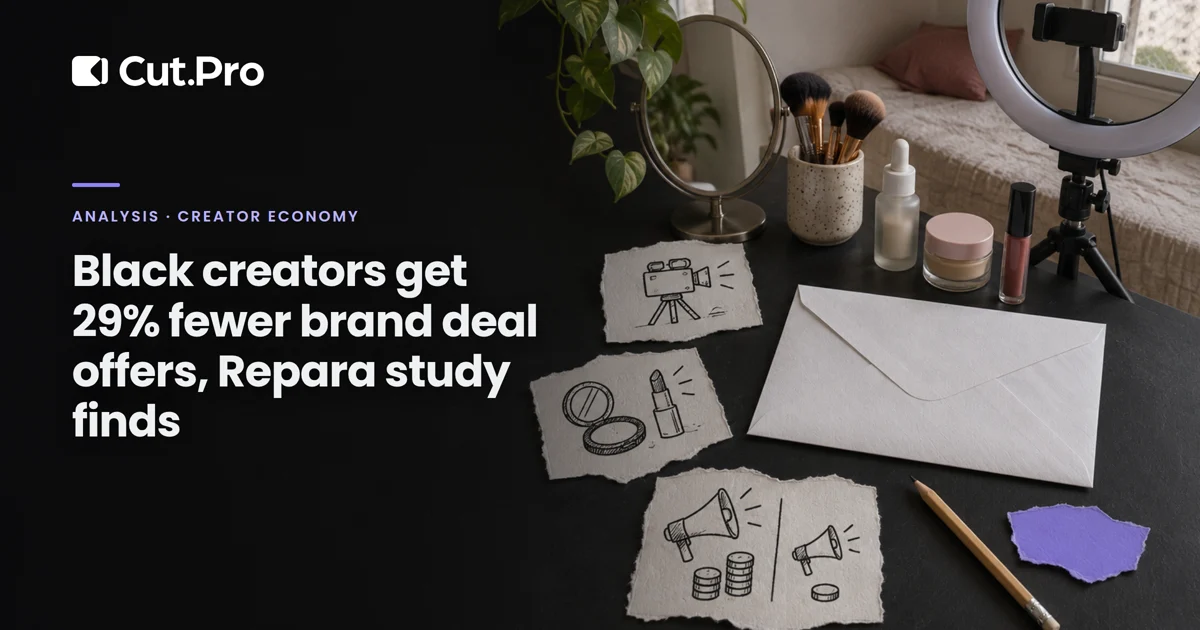
Black creators in Brazil receive on average 29% fewer commercial offers and 32% lower fees than white creators, according to the Repara study from Groupe L'Oréal in Brazil with the agency Spark and Instituto MC15, released in November 2026 with 16,200 respondents (Fast Company Brasil, Meio & Mensagem). My take: the problem isn't only the fee. It starts earlier, when a brand builds the list of who gets the brief.
The topic came back into the news this weekend with a Startupi report that opens with a different number: 57% of Black creators have never been hired for a campaign. Before you use that figure in a conversation with a brand, it helps to know where it comes from.
Where does the 57% figure come from?
It comes from a 2020 survey, not from 2026. It's "Black Influence: um retrato dos creators pretos do Brasil" (a portrait of Black creators in Brazil), run by Black Influence, Mundo Negro, YouPix, Squid and Sharp with 767 creators and reported by Meio & Mensagem in September 2020.
And the number at the time wasn't exactly 57%. Meio & Mensagem's coverage says 64% of all respondents had already done a campaign and 47% of Black creators had never taken part in advertising. Curiously, 57% is the share of white creators in the sample (56.8%), which suggests the figure got mixed up somewhere between 2020 and now.
That doesn't change the direction. The same survey already showed an average price per post 12% lower for Black creators (R$ 496 versus R$ 564 for white creators, in Brazilian reais) and 64% of them saying the market was not inclusive. What changes is the date: it's a snapshot from six years ago, before TikTok Shop, before deals with discount codes and before performance-based pricing. To talk about 2026, the data to use is Repara.
What does the Repara study actually measure?
It measures how many offers arrive, how much they pay and which follower tier each group falls into. The main numbers, according to Fast Company Brasil and Diário do Grande ABC:
| Cut | Black creators compared with white creators |
|---|---|
| Commercial offers, full sample | 29% fewer |
| Fee, full sample | 32% lower |
| Offers, profiles with more than 50,000 followers | 18% fewer |
| Fee, profiles with more than 50,000 followers | 25% lower |
| Average audience | 26,401 vs. 41,857 followers (37% smaller) |
The breakdown by profile size tells the same story from another angle. Black creators are 59% of nano and micro creators (up to 50,000 followers), 44% of mid-tier creators (50,000 to 250,000) and 38% of macro creators (more than 250,000). In other words, they enter in large numbers but drop out as the profile grows.
The barriers the creators themselves point to:
- 43% of Black nano and micro creators say it's hard to get brands to notice their work.
- 60% of mid-tier and large creators have trouble closing long-term contracts.
- 46% say the campaign invitation is the stage where racial inequality is clearest.
- One in five has been told to "tone down" some aspect of their identity.
- One in five feels they are hired to meet a diversity quota.
What are the study's limits?
The sample is almost entirely beauty. According to Fast Company Brasil, 97% of respondents are women, 86% work in beauty and only 24% make a living exclusively from content. That makes sense, because the study was commissioned by a beauty group that went looking at its own market.
But it's a limit worth stating. Repara doesn't measure gaming, comedy, finance, sports or clipping. I wouldn't expect a very different picture in those niches, because the selection logic is the same, but that's my opinion, not data.
Another point: none of the news reports published the full methodology or the data collection period. And Groupe L'Oréal Brazil's own CEO, Marcelo Zimet, told Meio & Mensagem that Black talent receives "on average 30% less", rounding the study's 29% and 32%. Use the numbers with their source, as with any commissioned research.
Why does the gap show up before the fee?
Because a brand deal starts with a list, and the list is built by people and by tools. The agency searches for profiles by followers, engagement and "brand fit", and whoever was hired before shows up again. A Black creator, with an average audience 37% smaller in the study, enters that search at a disadvantage, and the disadvantage repeats with every campaign that never arrives.
A comment from Loana Coelho, Marketing and Digital director at Groupe L'Oréal in Brazil, to Diário do Grande ABC goes in the same direction: the risk is that "racial identity overshadows recognition of professional expertise". In practical terms, it's the skincare creator who only gets invited in November, for Black Awareness Day in Brazil, and spends the rest of the year without a single product brief. The 2020 survey already described this, and the fact that only 8% of the Repara sample covers diversity among the topics they talk about shows that Black creators are not asking to be called only for that subject.
What do L'Oréal and its partners promise?
The goal is for Black creators to be at least 50% of the professionals hired in every follower tier, from nano to large, by 2030. To get there, Repara announced:
- A talent pool of more than a thousand mid-sized Black creators, built by L'Oréal and Spark with Human Data, where brands and agencies search by topic and see content and engagement. Profiles are curated, and being in the pool doesn't guarantee a contract.
- Training and mentoring for nano and micro creators, along the lines of the Beleza + Diversa program, which reached its third edition in 2026 with 10,000 applicants and one-year contracts for at least ten creators.
So far no report has said when the talent pool opens or how a creator can ask to join. If you work in beauty and have between 50,000 and 250,000 followers, it's worth following the channels of L'Oréal Brazil and Spark.
What changes for you as a Black creator?
The study gives you a reference number to negotiate with. If your average fee is below what similar profiles charge, there is now public data, from a major advertiser, saying that this gap exists and how big it is. That helps justify your price in the conversation, without having to prove on your own that the market is unequal.
Three things I would do starting today:
- Build the proposal around results, not just followers. The study shows that a smaller average audience weighs on the outcome. A brand that buys on performance looks at clicks, sales with discount codes and retention, and a smaller profile with an audience that buys can be worth more. The step-by-step is in the post on performance-based pricing.
- Ask for a long contract in the first conversation. If 60% of mid-tier and large creators get stuck on recurring contracts, offer a three-month package with a lower price per deliverable. What to negotiate beyond the post is covered in brand deal what to negotiate.
- Decline the invitation that only comes for a commemorative date, or counter it. Accept the November campaign and ask, in the same email, what the plan for the rest of the year is. Anyone who is only called to talk about race has a direct argument: the advertiser that commissioned the study says this is part of the problem.
For your audience to grow, the usual path still holds: post more often on the networks where your audience is. On Cut.Pro you can cut a long video or a livestream into several clips with captions and schedule them to multiple social networks at once, which helps solo creators keep a steady frequency without tripling the work.
And for brands and agencies?
The study is a direct request to change the brief. Repara suggests including diversity from the selection stage, and not only on commemorative dates, and reviewing how the agency searches for and curates creators.
In practice, that means searching for creators by topic and results, not from a list of who already worked with the brand. The AI discovery tools that platforms are opening up, like the Snap Creator Network, filter by performance and topic, and that tends to reduce the weight of whoever "the agency already knows". With $116 billion expected in brand spending on creators worldwide in 2026, leaving out most of Brazil's nano and micro beauty creators means leaving audience on the table.
My take
I have one caveat and one bet. The caveat: this is a study commissioned by a company that sells to the audience it measures, with a sample concentrated in beauty and no published methodology. Read it as a strong snapshot of one market, not as truth for every niche.
The bet: the number that will change something isn't the 32% on fees, it's the 29% on offers. Fees are negotiated one by one. An offer that never arrived can't be negotiated. If the goal of 50% by 2030 gets off the paper, it will show up first in the number of briefs, and that's what I would track in 2027.
Frequently asked questions
How much less do Black creators earn from brand deals in Brazil?
According to the Repara study, from Groupe L'Oréal in Brazil with Spark and Instituto MC15, released in November 2026, Black creators receive on average 29% fewer commercial offers and 32% lower fees than white creators. Among profiles with more than 50,000 followers, the gap shrinks to 18% in offers and 25% in fees, but it does not disappear.
Is it true that 57% of Black creators have never worked on a campaign?
The number appears in a November 2026 news report, but it comes from the Black Influence survey, run in 2020 with about 760 creators. Meio & Mensagem's coverage at the time reported that 47% of Black creators had never done any advertising. The data is six years old and should not be read as a picture of today.
What is the Repara movement?
It is an initiative of Groupe L'Oréal in Brazil, the agency Spark and the Movimento pela Equidade Racial (Mover), launched in November 2026. The goal is for Black creators to make up at least 50% of the professionals hired in every follower tier by 2030, backed by a talent pool of more than a thousand mid-sized Black creators for brands and agencies.
Does the Repara study apply to every kind of creator?
Not exactly. According to Fast Company Brasil, 97% of the 16,200 respondents are women and 86% work in beauty. The study is strong for that market and a useful signal for others, but it does not measure gaming, comedy or clipping, for example.