Creators now ask for equity in the brand, not just a fee: the Jetty case
The Poppi co-founder launched a new brand and heard a different ask from creators: instead of just getting paid for a post, they want to invest and become advisors. Here's why it's happening, when the trade is worth it, and what to get in writing before you take equity instead of a fee.
Creators now ask for equity in the brand, not just a fee: the Jetty case
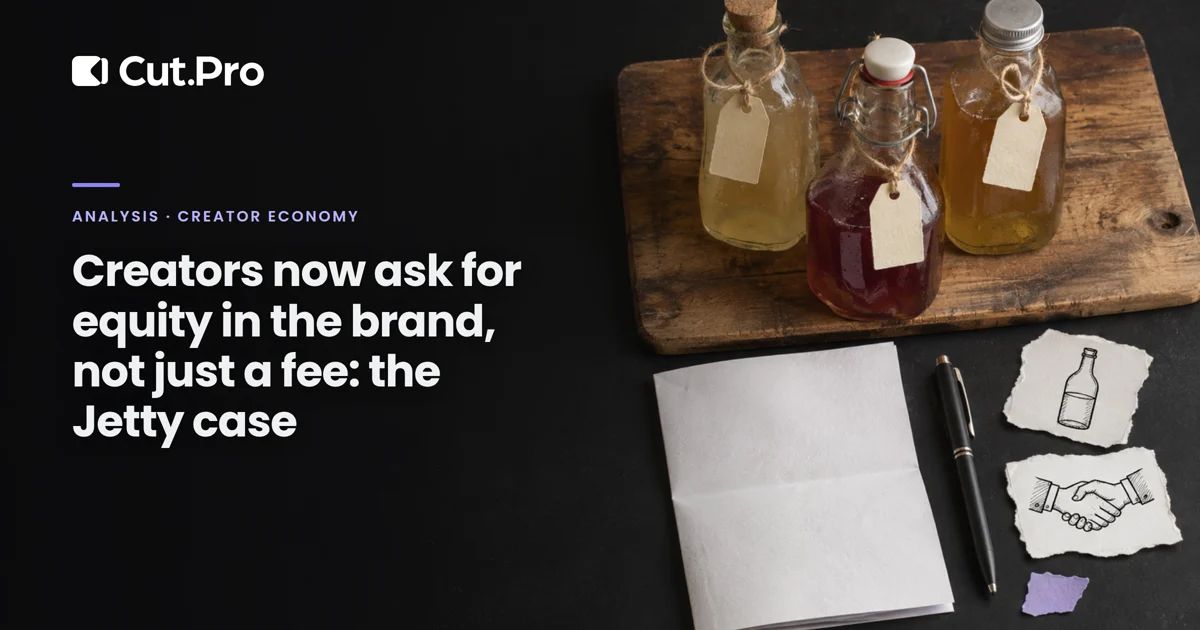
Allison Ellsworth, co-founder of Poppi, launched a new hydration brand on November 9. She said that when she reaches out to creators to promote it, they all answer with something other than a price per post: they ask to invest in the company and become advisors. My read is that this will reach Brazil through small brands before big ones, and that most creators still don't know how to negotiate this kind of deal.
The story first appeared in an interview with BeautyMatter on November 8, and was expanded on the Hot Smart Rich podcast, published on the 11th and summarized by Net Influencer. In her words, creators "ask to be advisors and to invest because they saw what happened with Poppi."
What is Jetty and why are creators looking at it?
It's a hydration drink, sold as a bottle and as a powder, available only in the United States, and the interest comes from the founder's track record.
According to Food Dive, Jetty launched in Whole Foods stores nationwide and on Target and Amazon's websites, with five flavors. Allison and her husband, Stephen Ellsworth, put in about $2.5 million of their own money and haven't raised outside capital yet.
The track record is Poppi, the apple cider vinegar soda that PepsiCo bought for $1.95 billion, counting $300 million in expected tax benefits, in a deal closed in May 2025. Poppi grew on the back of TikTok creators. Net Influencer points out that Alix Earle and Jake Shane had around 90,000 followers when the brand started working with them. A creator paid per post takes nothing from a sale like that: the gain goes to whoever holds equity.
What would these deals look like?
Investment plus an advisory role, with deliverables that change from person to person. Ellsworth didn't name names or percentages.
She described two models she's negotiating, according to Net Influencer:
- Active creator: one or two TikToks a month, a few appearances per quarter, one shoot day and the option to use the content in ads.
- Opinion leader with a small social following: the brand makes its "best effort" to land a podcast and a book tour spot, with no post target.
The detail that caught my eye is a different one. Investors post without brand approval, and Ellsworth said she wants creators to be able to fit the product into their routine "without putting a #ad hashtag on every post." In the US, Net Influencer itself reminds us that the FTC treats a financial relationship with a brand as a connection that must be disclosed. In Brazil, that part doesn't fly, and I'll come back to it below.
Is Jetty an isolated case?
No. In the US, at least two similar deals came out in recent months.
In July, ESW Beauty announced TikTok creators Katie Fang and Aliya Rachinski as the brand's first "creator partners," with a role in product development and campaigns, according to Net Influencer. In October, comedian Druski got an equity stake in Gopuff, the rapid delivery company, in a multi-year partnership, as reported by TheGrio. In both cases, the size of the stake wasn't disclosed.
The trend ties into another shift I've covered here: brands now demand results instead of paying per follower. Equity is the extreme version of that. The creator stops selling a post and starts betting on the results of the whole company.
Why would a brand give away a piece of the company?
Because it's swapping money it doesn't have for something that isn't worth anything yet.
A brand that starts with $2.5 million from its founders can't pay big-creator fees at scale. Offering a small slice before fundraising is cheap for the brand and ties the creator in for longer than a three-month contract. Ellsworth said each deal has to be "tailored" to the creator or investor, with no single template.
There's also the bet on small creators. Net Influencer cites an April report from the agency 5W, according to which about 70% of the product-seeding budget of consumer brands that get results goes to accounts with 10,000 to 250,000 followers. That fits with what I wrote about the shift of brand money toward micro and nano creators.
Who wins and who loses?
The creator with a loyal niche and some cash to spare wins. The one who swaps this month's rent for a promise loses.
Here's the math I'd run, with hypothetical numbers: a creator with 80,000 followers charges R$2,000 per video and makes two a month for a brand. Over a year, that's R$48,000 in their pocket. If the brand offers 0.5% of the company instead, valued at R$5 million, the stake is worth R$25,000 on paper. That paper only turns into money if the brand is sold, takes on investment with a buyback of shares or pays out profit. If it shuts down in two years, it's worth zero. If it becomes the next Poppi, it's worth far more than R$48,000.
Poppi is the exception everyone remembers, not the rule. Most new brands never reach a billion-dollar sale, and a creator's stake is usually a minority one, with no vote and diluted at every funding round. That's why I would never accept equity alone. The format that makes sense is a smaller fee that pays for your work, plus a slice that's the bet.
The brand that uses equity to dodge sponsorship disclosure loses too. That has a short shelf life, especially in Brazil.
What changes in Brazil?
Being a brand partner is a material relationship, so the post has to disclose it.
Senacon's Joint Ordinance No. 3/2026 (Senacon is Brazil's consumer protection agency) defines a material relationship to include ownership stakes. Anyone who posts about a brand they own part of has to say so prominently, and because being a partner is an ongoing relationship, the disclosure also goes on the profile for as long as it lasts. The wish to "not put #ad on every post" doesn't fit the Brazilian rule.
I think that's good for creators. Audiences already distrust undisclosed sponsored posts, and "I'm a partner in this brand" is a sentence that builds more trust than a buried "#ad." Someone with money invested in the product has an argument that a fee-only creator doesn't.
For now, Jetty only sells in the US, but the format works for any small Brazilian brand that wants creators without the cash to pay fees.
What to ask for before accepting equity
Everything in writing, and a corporate lawyer reading it before you sign. The minimum list:
- Percentage and the valuation used in the math. "0.5% of what?" Ask for the company value the brand has in mind.
- Dilution. With every funding round, your slice shrinks. Ask whether there's any protection.
- Vesting. If the stake is released gradually (vesting), what happens if the partnership ends midway.
- Instrument. In a new Brazilian company, it's common for the stake to come as a stock option or convertible contract, not as immediate ownership. Know which one yours is.
- Deliverables. How many videos, on which networks, with or without approval, and use of your content in ads, which should be paid separately.
- Exit. When the stake turns into cash and whether the brand can buy it back.
- Disclosure. Agree on how the relationship shows up on your profile and in your posts.
If the deliverable is one or two videos a month, as in the Jetty model, the same video can go out on all your networks. On Cut.Pro, you can edit, caption and schedule the post to TikTok, Instagram, Facebook, Threads, X, LinkedIn, Bluesky, Pinterest, Telegram, Mastodon, Discord, Dailymotion, Tumblr, Slack, Car.Media, and YouTube at once, which makes delivery cheaper and the slice easier to justify.
Where to start
If a small brand reaches out tomorrow, ask two questions before talking price: would you use this product without a contract, and how much of your fee can you give up without squeezing your month. If both answers are good, propose a reduced fee plus equity, with the seven points above on paper. If either is bad, charge your full fee. It's the same brand, and the product still has no guarantee of working out.