The 3 signals that weigh most in the Instagram algorithm in 2026
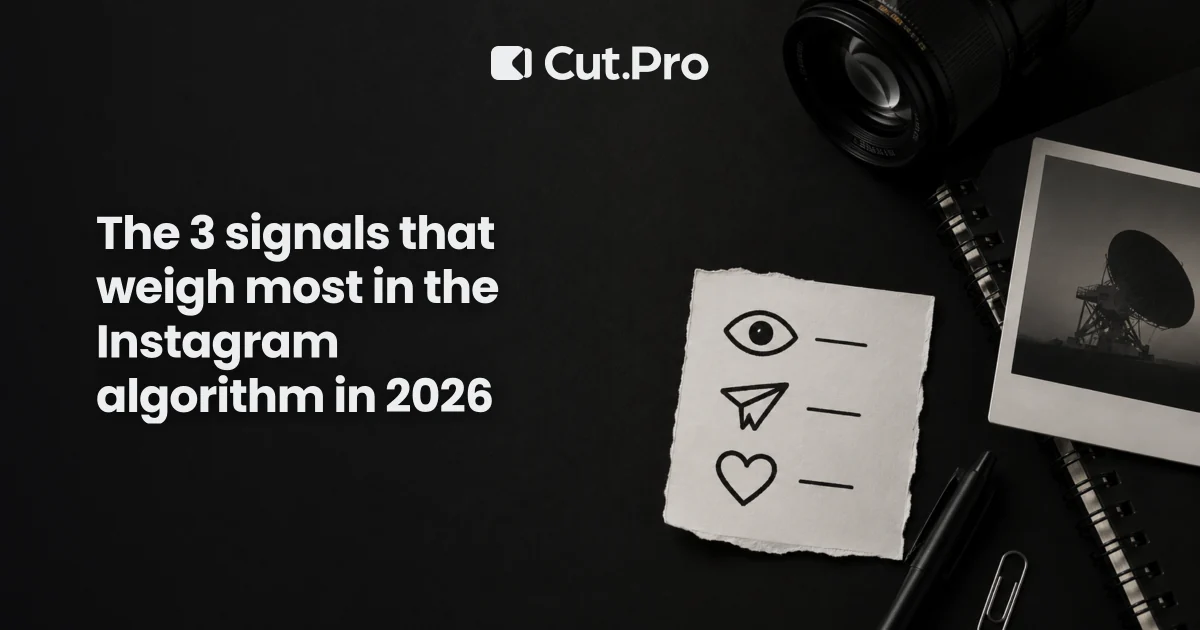
The head of Instagram named the three signals that move reach the most in 2026: watch time, sends in the DM, and likes per reach. I will break down each one and, more importantly, how to cut your clip for each signal, with examples of a cut people actually want to send to a friend.
The 3 signals that weigh most in the Instagram algorithm in 2026
Adam Mosseri, who runs Instagram, has said in public which three signals move a post the most in 2026: watch time, sends in the DM, and likes per reach. And he gave a sense of order. The share in the DM, the classic "send this to your friend", is the strongest engagement signal right now. When a post gets sent in the DM, it is pushed far wider than when it just collects likes.
That changes a lot for anyone cutting clips from livestreams and podcasts. We tend to cut asking only "does this look good?", when the right question is: what signal does this cut generate? Let me walk through the three, and mostly how to cut for each one.
Signal 1: watch time, and why the cut starts before it exists
Watch time is time watched. On Reels, the metric that truly rules is average completion rate. A thousand people who watch the clip to the end beat ten thousand who drop at the third second. Instagram even opened Explore distribution to Reels up to 3 minutes, but completion still decides reach, not length.
Cutting for retention is two things: hook and pace.
The hook means starting the clip at the peak of the line, not at its intro. The viewer did not open for "good morning, thanks for being here". They land on the line that matters. If the streamer says "I lost forty thousand dollars in a day and it was my fault", the cut starts at "I lost forty thousand dollars", full stop. The rest comes later, once you have bought the attention.
Pace is what holds people after the hook. Cut the pauses, the "uh", the "like, you know", the long breaths. A two second silence in the middle of the clip is people leaving. If you want to go deeper on that, I wrote a whole post on hooks for the first seconds that pairs with this part.
Signal 2: sends in the DM, the cut people want to send to a friend
This is the strongest signal and, in my view, the most underused by people who cut. Everyone thinks about the like. Almost nobody cuts asking "will someone tag a friend on this?".
Sending in the DM is a gesture that costs effort. The person stopped, thought of a specific friend, and sent it. Instagram reads that as real person to person value. And here is the point: some kinds of cut practically beg to be sent. Here are the four that work best.
Identification, the "this is you". The cut that describes a behavior the viewer instantly recognizes in a friend. A podcaster says "there is a type of person who walks into a restaurant and asks for the wifi before the menu". Whoever watches thinks of someone and sends it. The cut does not have to be a joke, it has to be recognizable.
The absurd. A line or scene so far off the curve that the natural reaction is "dude, you have to see this". A streamer reacting to an insane number, an opinion nobody expected, a story that sounds made up. The cut becomes almost a "look what this guy said".
Useful information. The cut someone sends because it helps the friend. "Hey, this is what I told you about taxes." A slice of a finance podcast with a concrete tip, a short how-to, a stat that changes a decision. Usefulness travels in the DM because it feels like a favor.
Debate. The cut that splits opinion in a way that makes the viewer want the friend's take. A bold claim said with conviction. They send it in the DM writing "do you agree with this?". Instagram sees the send, and you get the comments as a bonus.
In practice, when you review your cuts, ask one question for each: who would I send this to and why? If you cannot answer, the cut will probably just brush against a like and stop there.
Signal 3: likes per reach, the clear emotional peak
Likes per reach is how many likes a post gathers relative to how many people it reached. It is a cheaper signal than the DM, but it still counts. And the like comes from one thing: a clear emotional peak.
A like is a fast reaction. The person feels something and double taps the screen without thinking much. So the cut that gathers likes is the one with a sharp emotional moment: the loud laugh, the line that gives you chills, the twist, the "I cannot believe he said that". A cut that is lukewarm from start to end, even when it is edited well, does not pull a like because there was no peak.
The common mistake is diluting. Someone grabs a good 40 second slice but the peak is at second 30, with 30 seconds of lukewarm context before it. Cut to reach the peak fast. Keep the context to a minimum, just enough to make sense, and deliver the emotion before the attention runs out.
What Instagram is now punishing, and why it matters for clippers
There is a 2026 detail you cannot ignore. Instagram is down-ranking non original content aggressively: reposts from another account, clips with a TikTok watermark, and old posts recycled with nothing new. For anyone who cuts and distributes across several places, this is serious. If you export with the TikTok watermark and upload to Reels, the reach is capped from the start.
The fix is to post the clean file on each platform, with no watermark from another network, and treat each cut as original there. That ties straight into turning views into real followers, because capped reach does not become followers.
Where Cut.Pro fits in
The tedious part of cutting for three different signals is the mechanical part: finding the moment inside two hours of livestream, reframing vertical following the face, trimming pauses, adding captions. That is where Cut.Pro helps. You paste the link to a livestream, a VOD, or a podcast, and it finds the best moments, reframes them vertical following the face, adds captions, and suggests a title and hook for each clip. It also translates and dubs, if you want to take the same cut to another audience.
What is left for you is the decision no machine makes: is this cut retention, DM, or a like? Would someone send this one to a friend? The tool hands you ten ready cuts in minutes. You pick which ones become the "this is you", which become the emotional peak, and you build the clip around the signal, not just the look. The caption also drives retention, and if you want to sharpen that there is a post just on captions built for retention.
In the end, the algorithm did not change the game that much. It just got clearer about what it rewards. Retention, sends in the DM, and likes are still people reacting to a good moment. Your job is to find that moment and deliver it clean, fast, and at the right emotional point.