Your YouTube back catalog can now earn on Tubi, Spotify and Facebook
A true crime channel earned $154,000 in September by redistributing old YouTube videos to Spotify, Tubi and Facebook, more than 1.8 times what YouTube paid it that month. Here is how syndication works, what already applies in Brazil and what I would check in the contract before handing over a catalog.
Your YouTube back catalog can now earn on Tubi, Spotify and Facebook
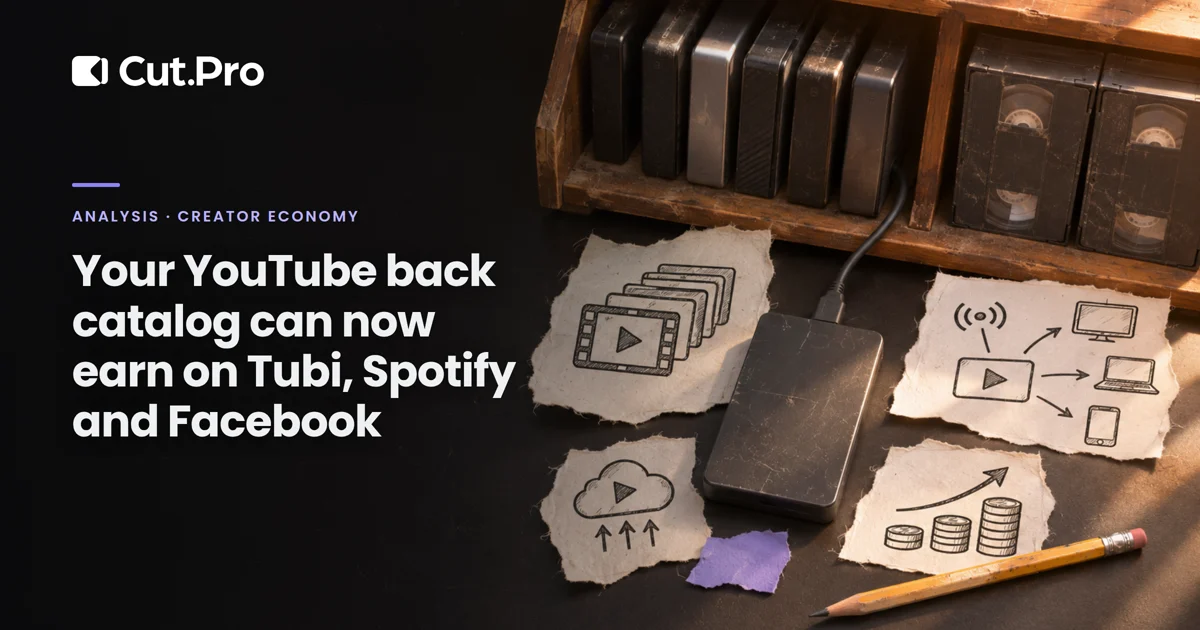
An anonymous true crime channel earned $154,000 in September from old YouTube videos redistributed to Spotify, Tubi and Facebook. That is more than 1.8 times what the same channel received from the YouTube Partner Program that month, according to Chanel Simmons, a director at the distributor Motion Society, speaking to Digiday on Wednesday, November 18.
My takeaway: a video that has already paid for itself is no longer idle inventory. It is an asset you can license. But in Brazil, half the doors in this market are still closed, and anyone who goes through a distributor gives up revenue and, sometimes, control.
What does it mean to syndicate your YouTube back catalog?
Syndicating means taking videos that already ran on YouTube and putting them, again, on platforms that pay for audience. The term comes from TV, where the same series is resold to several channels after its premiere.
Digiday names three kinds of destinations:
- Free ad-supported TV, which the industry calls FAST (free streaming channels paid for by advertising): Tubi, Roku, Samsung TV Plus and Pluto TV.
- Spotify, which works for video in podcast format.
- Facebook, which works better with long-form video.
Motion Society has been doing this since 2022. It says it works with more than 650 creators and IP owners and distributes more than 30,000 videos a month across more than 20 platforms and TV services.
How a distributor turns a YouTube video into a TV show
The work is re-editing, not reposting. From what Digiday described of Motion Society's process, there are four steps:
- Curation: pick the videos and group them into seasons that make sense together.
- Re-editing to TV standards: remove host-read ads, the "subscribe" call to action, watermarks, segments that fail brand safety rules, references to other videos on the channel and the captions burned into the video.
- Packaging: original art for each show and season, in each platform's format.
- Testing: A/B tests of strategy across platforms.
Payment is usually a revenue share, and the company did not disclose the details.
Step 2 matters most for anyone producing today. Burned-in captions, which hold retention on Reels and TikTok, get in the way on TV, where captions come from the device. And the host-read ad, which pays for the video on YouTube, becomes a contract problem outside it.
Why is this happening now?
Because free TV platforms have to fill a 24-hour schedule, and creators have hours of video with a proven audience. Tubi launched Tubi for Creators in June 2025 to license shows from YouTubers, and today, according to Digiday, it licenses Joey Graceffa's mystery series and Kinigra Deon's drama and comedy series. Kudzi Chikumbu, from Tubi, said creator partnerships pay through revenue sharing.
At the same time, Netflix and YouTube are competing for creators with contracts and original series, as I covered in the post on YouTube Creator Premieres, and Apple opened a video podcasts section on Apple TV. Everyone wants creator video on the big screen.
Jonathan Chanti, from Reign Maker Group, summed up the shift for Digiday: the focus moves from growing an audience to monetizing what already exists.
Who wins and who loses?
The winners are creators with lots of long-form, evergreen video. True crime, documentaries, cooking, travel, interview podcasts, series with a beginning and an end: material that will still make sense in two years and fits into a season.
The losers, or the ones who never get in, live off videos that depend on the moment. News reactions, commentary on this week's controversy and videos tied to a mid-roll host-read ad age fast and take a lot of re-editing.
Distributors win too. Keith Bendes, from Linqia, called the model a "new MCN." An MCN is a multichannel network, the agency that in the 2010s bundled YouTube channels and kept a share of the ad revenue. This time the product it sells is distribution.
And there is an open question that affects your next brand deal. Bendes listed the questions nobody has answered yet: who keeps the extra reach, whether the sponsorship follows the syndicated version, and how usage rights, exclusivity windows and brand safety clauses will work. His bet is TV-style sponsorship pricing, with a premium for cross-platform reach and brands asking for proof that the reach is real. I have already written about what brands usually ask for beyond the post in brand deals from the inside.
What already works in Brazil?
Spotify and Facebook already pay in Brazil. Tubi does not officially operate here. I checked each door on November 18, 2026:
| Destination | How the video gets in | Status in Brazil |
|---|---|---|
| Spotify Partner Program | You do it yourself, hosting on Spotify for Creators | Live since October 19, according to Canaltech |
| Facebook Content Monetization | You do it yourself, posting to your page | Invite-only program, with an interest form |
| Samsung TV Plus and Pluto TV | Channel deal with the platform | Operating in Brazil |
| Tubi | License, through the creator program or a distributor | No official launch in Brazil |
On Spotify, the requirements on the official page are three published episodes, 2,000 hours of playback and 1,000 unique listeners or viewers in the last 30 days. Video is paid by time watched per Premium subscriber, and Spotify did not disclose how much it pays per hour in the Brazilian announcement, according to Canaltech. Spotify's other income model for podcasts, fan subscriptions, is covered in the post on Spotify Memberships.
On Facebook, payment comes from performance (views and engagement) and applies to long-form video and Reels. Creator Fast Track, which arrived in Brazil this month, pays only for Reels and excludes anyone who posted Reels to their page in the last six months, so it is not the door for a long-form catalog.
On free TV, the path exists, but it is for entire channels. CazéTV, which was born on the internet, got 24-hour programming on Samsung TV Plus in 2024. For a mid-size creator, that takes volume and someone to negotiate with the platform.
What I would do with my catalog starting today
- Separate the evergreen. Open YouTube Studio and list the long videos more than a year old that still get views. That is your real catalog; the rest is of no interest to anyone.
- Keep a clean version of everything you record from now on. A file without burned-in captions (captions go in a separate file), with the host-read ad in a block that is easy to remove and no "subscribe" in the middle. It costs almost nothing in editing and saves you the re-edit later.
- Start with Spotify if you have a video podcast. It is the door you can open on your own, with no distributor and no revenue split with a middleman.
- Read the distributor's contract as if you were selling the channel. Percentage, term, exclusivity per platform, who owns the re-edited version, whether reporting is monthly and per platform, and how to exit. Chanti warned Digiday about the risk of trading control of your intellectual property and your relationship with your audience for a small gain now.
- Review your old sponsorships. A video with a host-read ad only goes to another platform with that segment cut or with the brand's approval.
A catalog also earns the way readers of this blog already know: clips. On Cut.Pro, you paste the link to an old YouTube video, the AI returns the moments that stand on their own, already vertical and captioned, and the same dashboard publishes and schedules to TikTok, Instagram, Facebook, Threads, X, LinkedIn, Bluesky, Pinterest, Telegram, Mastodon, Discord, Dailymotion, Tumblr, Slack, Car.Media, and YouTube. To take the catalog to audiences outside your base, you can set up a clipping championship on top of it, as I compared in championship, agency or clip editor.
My take
This is the music catalog model arriving in video. A musician records once and a distributor puts the track on every streaming service. Lauren Lyster, from Go Fish Digital, raised the idea to Digiday that creators will start using distributors the way musicians do. I think that is where this is headed.
But I would treat the $154,000 figure as a ceiling, not an average. It is a case chosen by the company that sells the service, with no contract terms and no exact YouTube figure. And it is true crime, the genre that fits free TV best.
For Brazilian creators, the math today is more modest. Tubi is not here, Spotify does not say how much it pays and Facebook still chooses who gets in. What you can do now: treat every new video as something that will get a second life, and don't sign catalog exclusivity for a small advance. A year from now, whoever has a clean catalog organized into seasons will negotiate from a better position.