The one-minute paradox: how to post 60-second clips that monetize without killing retention
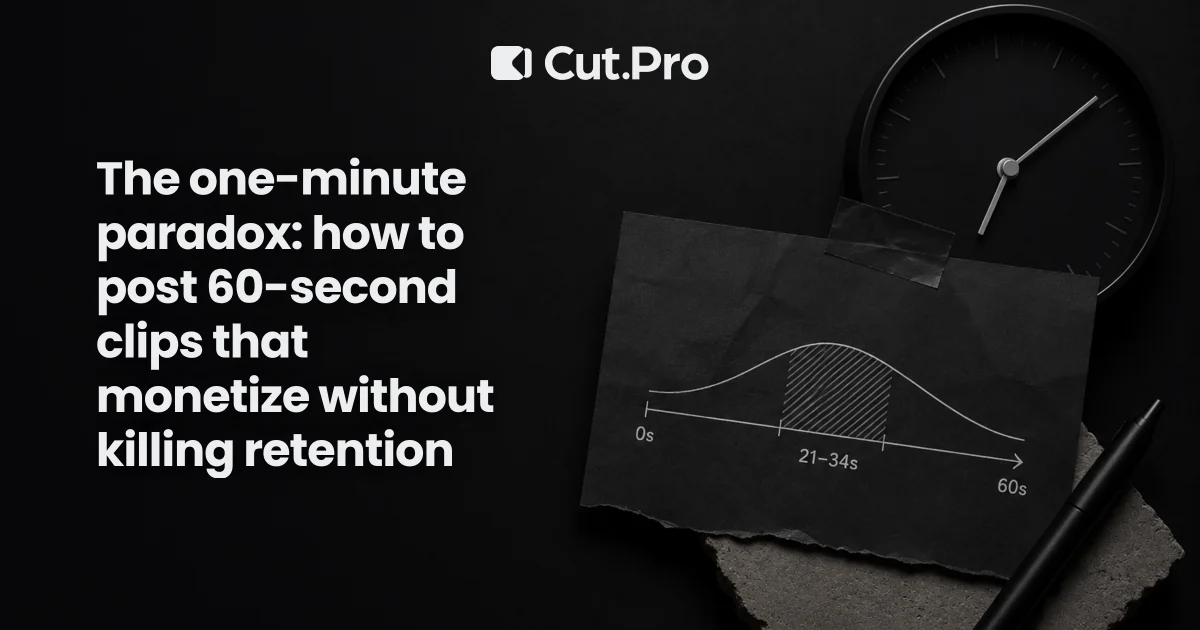
TikTok monetization only counts videos 60 seconds and up, but retention peaks between 21 and 34 seconds. That's the paradox leaving clippers stuck in 2026. Here's how to stretch a clip without losing the viewer halfway through.
The one-minute paradox: how to post 60-second clips that monetize without killing retention
There's a new trap waiting for clippers in 2026, and it's sneaky because it looks like a contradiction. On one side, TikTok monetization only counts views on videos 60 seconds and up. On the other, the data shows that completion rate, the metric the algorithm loves, peaks between 21 and 34 seconds and falls off a cliff after that.
Translated: the length that pays is exactly the length that's hardest to hold to the end. Stretch the clip to earn money and retention drops. Shorten it to retain and you vanish from the payout count. It's a real paradox, and most people are solving it the wrong way: dragging a twenty-second moment across sixty. Let me show you the right way.
Why stretching doesn't work
The instinctive mistake is to take the 25-second cut that already works and pad it with filler until it hits the minute. More context up front, a pause here, the good moment replayed in slow motion there. Done, 60 seconds.
Wrong. You didn't create a one-minute clip, you created a 25-second clip with 35 seconds of fat glued on. The viewer feels the drag instantly, leaves at second 30, and you came out worse: the algorithm registered that your content tires people, and starts serving it less. Worse than not monetizing is teaching the platform that your video holds no one.
Completion rate isn't a number to game. It's the most honest signal the algorithm has that your content deserves reach. Sacrificing it to reach the minute is trading the future of the account for a few cents today.
The shift: chain peaks, don't stretch one
A 60-second clip that retains isn't a long moment. It's several short moments chained together.
Think of it this way. That 22-second cut that works has a clear structure: hook, tension, turn. It's a complete, closed arc. A 60-second clip that holds is three or four of those arcs in a row, each with its own hook, linked by a promise that pulls into the next. The viewer doesn't stay because the video is long. They stay because every 15 seconds something new happens that made it worth staying.
It's the same logic as the narrative structure of hook, tension, and turn, just applied in layers. Instead of a single cycle, you stack cycles. Each turn resolves one tension and opens the next. Whoever watches never reaches a dead point where the question "why am I still here?" shows up.
The cliffhanger in the middle
The most underrated tool for the long clip is the internal hook, planted well before the end.
Around second 20, when the attention curve naturally starts to dip, you drop a promise of what's coming: "but what he said after that changed everything," or simply the cut that suggests the best part hasn't arrived yet. It's the same principle as the cliffhanger clip series, only inside a single video. You give the viewer a concrete reason to cross the middle where everyone else quits.
And remember the opening hook still rules. If the first three seconds don't grab, it doesn't matter how good second 40 is. In a long clip the opening hook has an extra job: it has to promise the minute is worth investing, not just two seconds of curiosity.
Not every piece of material can carry the minute
Here's the decision that comes before the edit, and that almost no one makes on purpose: not every moment was made to be long.
A scare, a two-second one-liner, an instant fail, a lightning clutch. Those are single, dry peaks. Stretching them is killing them. They go to the short clip, which grows the profile and hooks followers.
Now a podcast segment with a setup, tension, and a payoff; a roleplay arc that builds to a climax; an explanation that delivers a real reward at the end; a back-and-forth beef. Those have narrative breath. They carry the minute on their feet because they were born with several beats inside. Those are your raw material for the long clip that monetizes.
The practical rule I use: if, watching the raw material, you can point to at least three turning moments inside a 60-to-90-second window, it's a long-clip candidate. If there's just one peak and the rest is the road to it, it's a short clip. This ties directly to the 60-90 second rule: the right length is what the content sustains, never what the monetization target demands by force.
The pacing inside the minute
Even with the right material, the minute is won or lost in the cut. A long clip can't breathe like a long video. Every pause has to earn its place.
Hard cut between the beats, no lazy transition stalling. Strip the "uh... so... let me see" out of the middle of lines, because in a 60-second clip every dead breath costs you. It's the hard-cut pacing that keeps the sense of speed even in a longer format. The goal is for the viewer to reach second 60 surprised a minute already passed, not relieved it's over.
And since the work of finding three peaks inside a segment and cutting the fat between them is exactly what eats time, that's where Cut.Pro's AI clipping comes in: it sweeps the material marking the energy peaks, so you quickly see where the beats are that can be chained into a long clip, instead of watching everything by eye to find them.
In the end, the one-minute paradox dissolves when you stop thinking about "stretching" and start thinking about "chaining." TikTok monetization isn't asking for a longer, more boring video. It's asking for a video that deserves a minute of someone's attention. And that, at its core, is just the same old craft, done with a bit more breath. Whoever masters the short and learns to stack monetizes without ever betraying the retention that brought the viewer there. For the companion strategy and the program requirements, it's worth reading how much Creator Rewards actually pays.