Fortnite's Clix puts nine businesses under one holding company: what to copy
Cody "Clix" Conrod, a pro Fortnite player with more than 26 million followers, put nine businesses under Full Box, including a clipping agency. Here is how the holding is built, where his revenue comes from, and what a smaller creator can copy without starting a company.
Fortnite's Clix puts nine businesses under one holding company: what to copy
Cody "Clix" Conrod, a pro Fortnite player with more than 26 million followers across platforms, put nine businesses under a holding company of his own, Full Box Inc., launched in early October and detailed by Digiday this Friday (27th) (Digiday). The announcement itself dates to October 1, when Variety got the exclusive (Variety, via Yahoo). What the new report adds is the part that matters to anyone who makes a living from content: where his money comes from and why he wants a company that grows without his face in every video.
My take: the holding is the least important part of the story. What's worth copying is the split it exposes between income that depends on the creator showing up and income that doesn't.
Who is Clix and what is Full Box?
Clix is a pro Fortnite player who was voted best Fortnite streamer at The Streamer Awards in 2024, and Full Box is the company that organizes everything he has built around the game. He started playing video games at five and streaming at 13, according to Digiday. The follower counts the report lists are 8.73 million on Twitch, 6.7 million on TikTok, more than 5 million on YouTube, 2.86 million on X, 2.81 million on Instagram and 848 thousand on Snapchat. The Full Box website cites 28 million followers combined and more than 1.5 billion views in 2025.
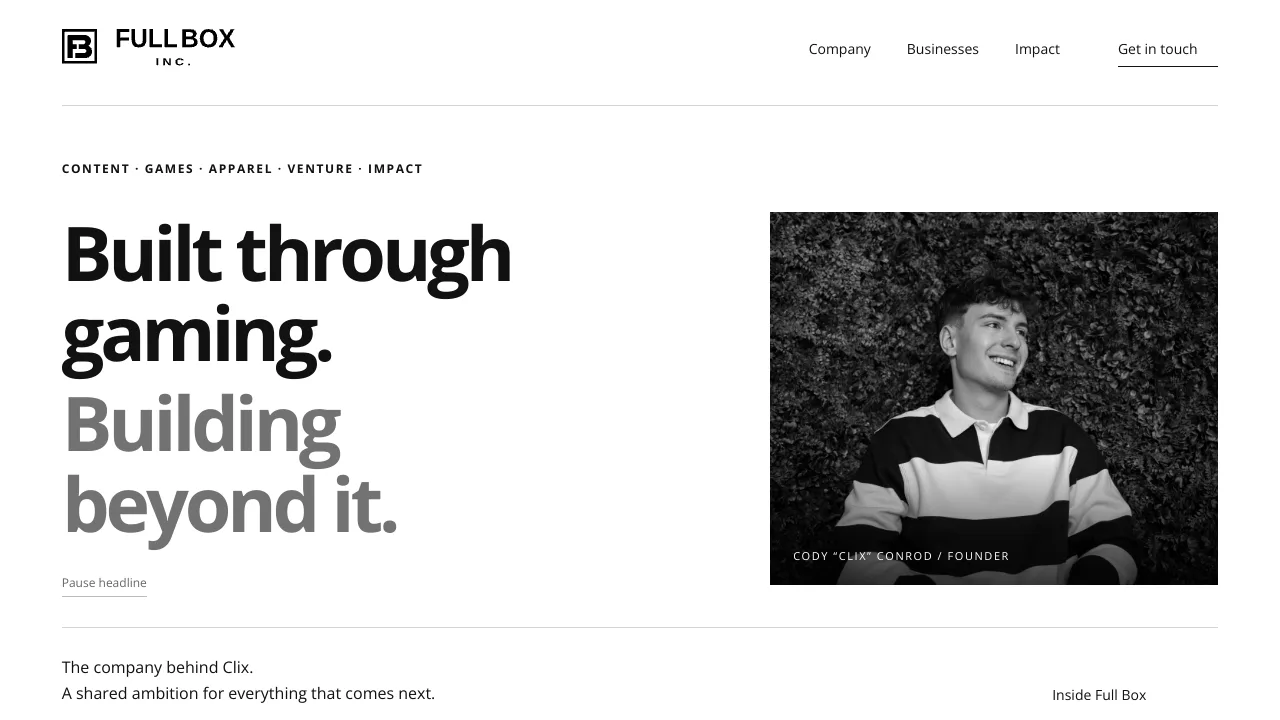
Darren Glover, the CEO, runs the company. He was Clix's first agent and spent six years building the gaming division at VaynerSports, where, according to the Full Box site, he closed more than $20 million in brand deals. Clix is the founder, holds the title of creative director and keeps competing and streaming.
How are the nine businesses split?
There are three pillars, and the split says more than the list (Variety, via Yahoo):
| Pillar | Businesses | What it is |
|---|---|---|
| Owned companies | Clix Gaming, Clix Creative, Dr3amin | Content and streaming, a studio that builds maps and experiences inside Fortnite, and an apparel brand |
| Full Box Ventures | Reach Clipping, Real Sports, Rorra, TapCaps, XSET | Stakes: a clipping agency, a sports app, a water filter, collectibles created with the streamer Lacy and the esports organization he co-owns |
| Impact | Dr3amin Access Fund | A fund that gives gaming PCs and training to young people; the Clixmas event gave away more than $250 thousand in equipment in 2025 |
Glover summed up the change to Digiday in one sentence: it wasn't about starting something new, it was about putting an umbrella over what already existed. He told Variety the model is vertically integrated: Fortnite pays the people who play, and the company adds the creator code and the studio's experiences, which earn based on engagement.
Where does his money come from?
About half comes from brand partnerships, and the rest from sources that don't depend on closing sponsorship deals. According to Digiday, that rest is split between Twitch and YouTube ads, royalties from things he owns and Epic's Support-A-Creator program, which pays the creator 5% of purchases made with his code. No amounts were disclosed.
Glover also said the business "is profitable and runs without a single dollar from brands." In his version, brand money isn't what keeps the company going: it's used to invest in more partnerships. Without the numbers, there's no way to check. But the message is clear, and it holds for a channel of any size: sponsorships are the most volatile income a creator has, because they depend on another company's budget.
Why does he want to grow without his own face?
Because everything that depends on him has a ceiling: his schedule, his health and his willingness to keep going. Clix told Digiday he wanted to build things bigger than himself, and the report describes the goal as businesses that grow without depending on his presence. The report compares the move to the MrBeast model, who also built companies around his channel.
Two practical details from the report show how this plays out in a gaming creator's day to day:
- Sometimes he can't stream during a tournament because of stream sniping, when an opponent watches your broadcast to see where you are. Anyone who competes and streams at the same time loses matches because of it. Having content that doesn't depend on the stream solves part of the problem.
- Glover built a content stockpile so he has something to post when he isn't streaming at a tournament. Ready-made material in the queue is what keeps the channel active on days when the stream doesn't happen.
Why is a clipping agency on the list?
Because clipping has become performance-paid distribution, and whoever controls distribution earns on both sides. Variety describes Reach Clipping as the fastest-growing clipping agency on Content Rewards, the campaign platform that pays clippers per view, and says it helps creators and brands distribute short video. Glover had already appeared in Digiday's report on the new phase of clipping, separating real clipping (an editor turning material into a new video) from mass reposting, as I covered in clipping enters a new phase.
Clix isn't the only one. MrBeast has Vyro, which turns clipping into an order with a deadline and pay per view (I explain the model here), and big streamers have been paying clippers for reach for a while (real money has entered clipping). The difference with Full Box is that the agency serves other creators and brands, not just the owner's channel. Clipping stops being a promotion cost and becomes one more business.
For people who clip, this cuts both ways. There's more organized money going into campaigns, with rules and payment. And there's more professional competition: an agency tied to a big creator picks who edits well and verifies views.
Who wins and who loses with this model?
The winner is the creator who already has an audience big and loyal enough to sell apparel, games and collectibles. For that creator, a holding is organization: it separates the cash of each business, makes it easier to bring in partners and investors, and puts an executive in charge of what isn't content.
The loser, or at least the one fooling themselves, is the mid-size creator who copies the structure before having the businesses. A holding with a single business is paperwork with an accountant's bill. In Brazil, the choice between MEI (the simplified regime for sole proprietors), a company and a holding depends on revenue and taxes, and it's a conversation to have with an accountant before any step. The basics for people paid for content are in clipper taxes in Brazil: how to declare.
And there's a catch the report doesn't resolve. Half the revenue still comes from brands, and the fame that sells the cap and the map in Fortnite is still Clix's. "Growing without the face" is the goal; for now, the face is still carrying a good part of the bill.
What I would copy, without starting any company
The small version of Full Box fits in a spreadsheet and three decisions.
- Split your income into two columns. On one side, what depends on you showing up and someone approving (sponsorships, event appearances). On the other, what comes in without negotiating (platform ads, affiliate, creator code, your own product). If the first column goes above two thirds, you're exposed to someone else's marketing budget.
- Build a content stockpile. Seven days of posts ready in the queue change your week. Clips from old streams, behind-the-scenes and replies to comments go in there.
- Organize who clips you. The small equivalent of Reach Clipping is having written rules for clips of your content and knowing who is posting. A clipping championship on Cut.Pro does this without hiring a team: you write the rules, choose the accepted platforms, set the prize, and every submitted clip is checked before it counts. I explain the format in clipping championships: how they work and how much they pay.
If you're a gaming creator, it's also worth looking at what the game pays directly. Fortnite's Support-A-Creator is an example of income that doesn't depend on sponsorships, and clips of the game are what bring people to your code; the step-by-step for clipping is in how to clip Fortnite.
None of this gets you to Clix's size. But the question Full Box answers works for any channel: if you stopped recording for a month, how much of your income would keep coming in?