Brazil is 2nd in Instagram creators but only 10th in money
Brazil has 4.4 million active creators on Instagram, behind only the United States, yet its creator market is worth $5.2 billion and ranks 10th worldwide. I ran the numbers on money per creator and what it means when you price a sponsored post.
Brazil is 2nd in Instagram creators but only 10th in money
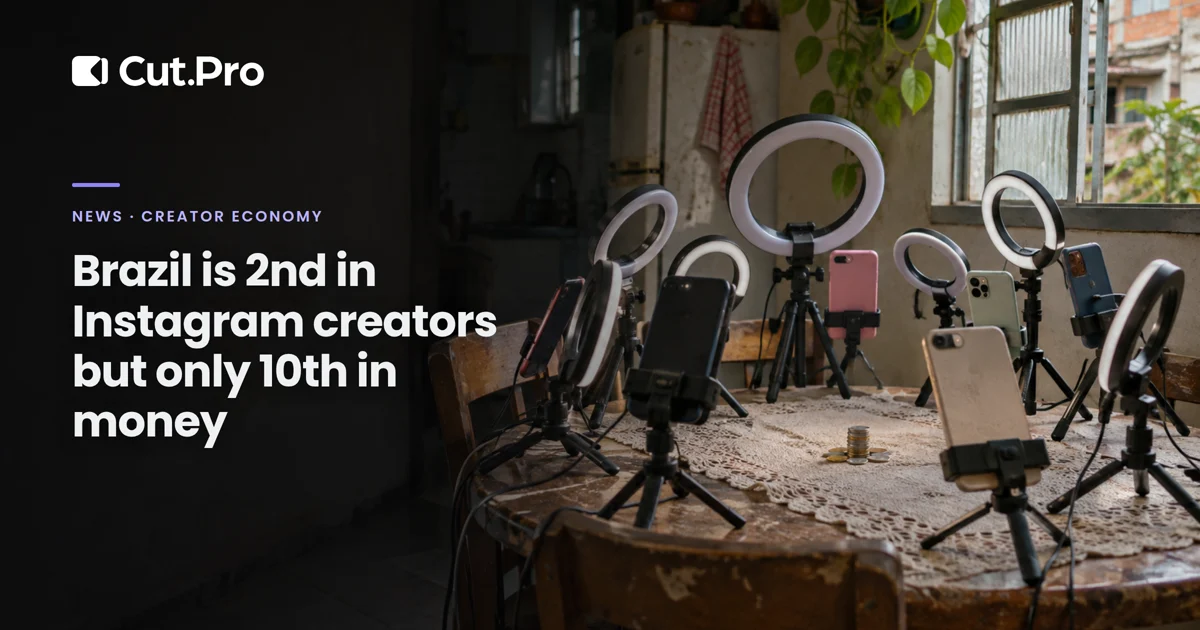
Brazil has 4.4 million active creator accounts on Instagram, the second largest base in the world, yet its creator market is worth $5.2 billion and ranks only 10th. Mundo do Marketing put the two numbers side by side this Thursday (Nov. 26), and the message is simple for anyone who lives off sponsored posts: too many people are splitting too little money, and pricing by follower count is a losing strategy.
Where do the numbers come from?
They come from two different studies, which matters when you read the comparison. The creator count is from HypeAuditor's report State of influencer marketing in Brazil 2026: 4.4 million active profiles, 10.2% of the platform total, against 5.2 million in the United States.
Market value comes from the Creator Economy Report 2026, produced by the consultancy Coherent Market Insights with BNP Paribas and Influential and presented at Paris Creator Week in early November. It puts the global creator economy at $217.3 billion in 2026. Advanced Television, which covered the report, lists Brazil at 4.6 billion euros, behind France, Japan and South Korea, which matches the $5.2 billion from Mundo do Marketing.
| Brazil | United States | |
|---|---|---|
| Active Instagram creators | 4.4 million (2nd) | 5.2 million (1st) |
| Creator market value in 2026 | $5.2 billion (10th) | $69.8 billion (1st) |
| Annual spending per person | $24.40 | $200.80 |
Spending per person and the growth projection appear only in the Mundo do Marketing article, which does not explain the methodology or link the full report. Treat those two as consultancy estimates.
How much is that per creator?
A back-of-the-envelope calculation gives roughly $1,200 per creator per year in Brazil and $13,400 in the United States. Eleven times more.
The math is deliberately rough. Market value includes what goes to platforms, tools and agencies (according to Advanced Television, the report says 42.6% ends up in the creator's pocket) and adds up YouTube, TikTok and the rest, while the headcount is Instagram only. But the proportion is what matters: Brazil has 10.2% of Instagram's creators and only 2.4% of the world's creator economy money.
Why does Brazil pay so much less?
The gap in spending per person explains most of it: the US market moves eight times more money on creators per person. Exchange rates and income weigh in, of course.
The other reasons are local. The article points to a large informal market and creators' difficulty pricing their own work. Fabio Gonçalves, from the agency Viral Nation, tells Mundo do Marketing that Brazilian creators still live on "one-off campaigns" when they could join longer, measured strategies.
There is also the paperwork. In Brazil, the profession entered the Brazilian Classification of Occupations in 2021, but only for statistical purposes, and there is still no economic activity code of its own for creators: the Ministry of Entrepreneurship discussed creating one in July 2026, according to the report. My read: without easy invoicing, it is hard to move beyond one-off campaigns with big brands.
What changes when you price a brand deal?
The yardstick changes. When the market has a lot of creator supply, the price per follower collapses, because someone with the same number is always charging less. What escapes that competition is what few people offer.
In practice, this is how I would build the proposal:
- A package, not a post. Charge separately for production, usage rights and each extra network. I explained how brands put this request together in brand deals from the inside, and usage rights are usually the line creators forget to charge for.
- A three-month contract instead of a single campaign. This is exactly what Gonçalves says is missing. Offer a discount for recurrence and you swap an isolated fee for predictable revenue.
- A results number, not a follower number. Brands are already building their own scorecard to decide which post to pay for, and retention, clicks and coupon sales weigh more than profile size.
- Invoices ready to go. In Brazil, having a CNPJ (business registration) and issuing invoices takes you out of the informal queue, and after the Senacon rule, brands want a formal contract and clearly labeled ads.
If you already post the same video on several networks, that goes into the price as extra reach. On Cut.Pro you can schedule the same clip to TikTok, Instagram, Facebook, Threads, X, LinkedIn, Bluesky, Pinterest, Telegram, Mastodon, Discord, Dailymotion, Tumblr, Slack, Car.Media, and YouTube at once, and each network's report becomes an argument at renewal.
Will growth make this better?
Maybe, but not for everyone. The projection cited is 30.6% a year between 2026 and 2033, the third fastest pace in the world, behind China and South Korea. If the rate holds, the Brazilian market would pass $30 billion in 2033 (my own math, based on the rate).
The catch: the creator base grows too. And new brand money is going to smaller creators with a clear niche and to formats that can be measured, as the projection of $116 billion in ad spend shows. Anyone who keeps selling loose posts by follower count will keep fighting over a slice that is already small.
What to do starting today
Open your latest proposal and check whether it sells a post or a package. Separate production, usage rights and extra networks, add a result number from a previous campaign and offer a three-month version. It will not change the size of the Brazilian market, but it changes the piece of it that stays with you.