Clipping championship, clipping agency or hired editor: what each one delivers
An editor, an agency and a clipping championship look like three prices for the same thing. They are not. Each one solves a different bottleneck: quality on your profile, steady volume or reach beyond your base. I compared the three on cost, predictability, volume, control and management effort, and say when each one makes sense.
Clipping championship, clipping agency or hired editor: what each one delivers
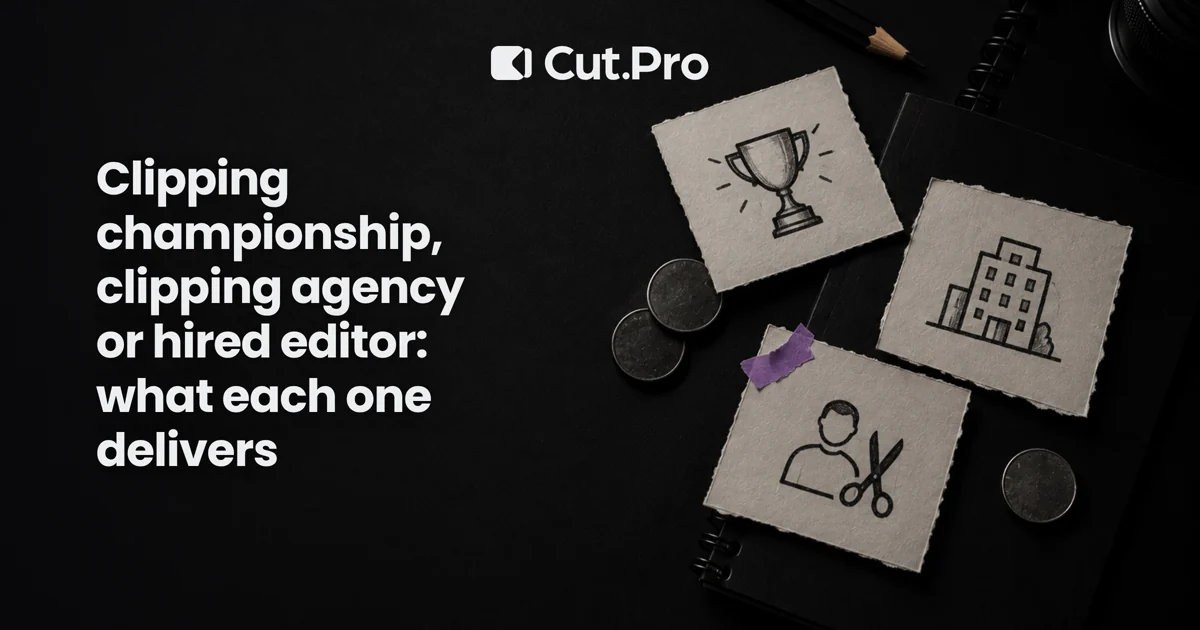
A hired editor delivers control and a single voice on your profile, charging for the work, per clip or per month. A clipping agency delivers steady volume with process, approvals and reporting, also on a monthly fee, and also on your profile. A clipping championship delivers reach spread across dozens of third-party accounts and pays for results (per thousand views, per post or ranking), with less control over each piece. Choose by bottleneck: if your profile lacks quality, an editor; if you lack hands for steady volume, an agency; if you lack reach beyond your base, a championship.
I sell championships, so be suspicious of my enthusiasm and check the math. But the question "which one is best?" is almost always the wrong question. They do not compete for the same job.
What each one is, in one sentence
- A hired clip editor is one person (freelancer or employee) who turns your long content into clips for your profile, following your taste, with you approving.
- A clipping agency is an operation with more than one person, a process and a contract, delivering an agreed number of clips per month to your profile, with batch approval and reporting.
- A clipping championship is a contest with a deadline and a prize in which clippers cut your content and post it on their own accounts; the prize is paid according to views delivered, approved posts or ranking position.
The difference that defines everything is in the last words of each sentence: where the video gets posted.
The table
| Criterion | Hired editor | Clipping agency | Clipping championship |
|---|---|---|---|
| Where it posts | Your profile | Your profile (sometimes brand profiles) | The accounts of dozens of clippers |
| How you pay | Per clip or per month | Monthly fee by scope | Per thousand views, per post or ranking |
| Cost | Fixed, for the work, views or not | Fixed, higher than one editor | Variable, with a ceiling known upfront; leftovers return |
| Predictability | High on pieces, none on views | High on pieces and deadlines, none on views | Maximum spend is predictable; number of pieces is not |
| Volume | Limited to one person's hours | Set by contract | Depends on how many join; can be very high |
| Quality control | Total, piece by piece | High, by batch and brand standard | Through rules and review; each clipper has their own style |
| Reach beyond your base | Low (one account) | Low (one account) | High (many audiences at once) |
| Management effort | Constant briefs and feedback | Batch approval and reporting meetings | Setting rules and reviewing the queue daily |
| Main risk | Depending on one person | Long contract with no results | Exaggerated or out-of-context clips |
Cost: what you are actually buying
I will not quote a market price table for editors and agencies, because it varies too much with niche, volume and deliverables, and any number I put here without a source would be a guess. The ranges and pricing models I see from the seller's side are in how much to charge for clipping. The point here is different: what each one charges for.
Editors and agencies charge for the work. A clip with 300 views costs the same as one with 300,000. That is not a flaw: you are paying for skill, time and consistency, and reach depends on your profile.
A championship charges for the result you choose. On Cut.Pro, creating one is free and the cost is the prize: from 500 credits, or for Brazilian organizers from R$ 5,000 in PIX, plus a 20% platform fee on the prize, shown before you pay. How to size that amount is explained in clipping championship budget. In the per-thousand-views model, each video earns a rate for every full 1,000 views of its own, with a minimum per video, a cap per video and a cap per participant; on PIX, any leftover balance goes back to your return key. As a market reference, with its condition: NPR reported in May 2026 on clipping campaigns paying between $0.50 and $25 per thousand views, depending on who pays and what is being promoted (NPR, via VPM).
Each one has a hidden cost. With an editor, it is your feedback time. With an agency, it is the minimum contract. With a championship, it is review: someone has to look at the queue every day.
Predictability: predictable in what?
This is the row of the table that confuses people the most.
Editors and agencies are predictable in pieces and deadlines: you know 20 or 100 clips will come out this month. They are not predictable in views, because reach belongs to your profile.
A championship is predictable in maximum spend: in per thousand views, the prize divided by the rate gives you the ceiling of paid views before you start. It is not predictable in number of pieces, because that depends on how many clippers join and how well your material performs. And the end date is a limit, not a guarantee: in per thousand views, the championship closes when the prize runs out.
If you need a fixed editorial calendar, go with an editor or an agency. If you need to know how much you will spend per unit of reach, a championship.
Quality control: the price of reach
The editor clips your way, because you correct every piece. The agency clips the contract's way, with a visual standard applied at the source and batch approval. In a championship, each clipper cuts their own way, and your control is indirect:
- Rules: an exclusive hashtag, on-screen text, required caption text, a bio link, your logo (the platform looks for it in each video and flags it in review when it is missing), up to 5 people who must appear.
- Review: you approve or reject each video, with a reason.
- Library and brief: you define what can be clipped and what cannot be said.
That is not the same as approving each piece before it is posted. The video is already live when it reaches your queue. Paying per view rewards whatever gets views, and sometimes that means exaggeration; I explained the risk in the dark side of clipping campaigns. If your brand cannot tolerate a single off-tone clip, a championship is not for you, or only with strict rules and daily review.
Distributed reach: the one column where a championship has no rival
Editors and agencies post on your profile. However good the clip is, it reaches your followers first and whatever the algorithm decides to show from your account.
A championship posts the same material on dozens of accounts, each with a different audience, at the same time. You find out which moment hooks people who have never heard of you, and that data is useful even for your editor. That is why, to me, the right comparison for a championship is not an editor, it is an ad; the math is in clipping campaigns for brands.
And there is a bonus that brings both worlds closer: the championship rules include a license in which the participant authorizes the organizer to republish the clips on the organizer's channels and profiles, including monetized ones, without transferring ownership of the video. The championship's best clips can become content for your own profile.
Management effort
- Editor: a brief at the start, feedback on every piece, a replacement when the person leaves. Little process, lots of conversation.
- Agency: a single point of contact, approval of moments or batches, reporting meetings. How an operation like that is organized so it does not jam is explained in clipping agency: delivering 100 videos a month.
- Championship: a four-stage form, manual approval by Cut.Pro within 2 business days, and then the review queue. Reports between participants are decided by Cut.Pro, not by you. The real work is reviewing quickly: participants can see how long their video has been waiting, and a stalled queue empties a championship.
When each one makes sense
| Situation | What I would choose |
|---|---|
| Small channel, inconsistent profile, small budget | Editor (or yourself, with an AI tool) |
| Podcast or brand needing 50 to 100 clips a month on its own profile | Agency |
| Lots of long material (streams, podcast, events) and little reach beyond your base | Championship |
| Launch or event with a short deadline | Per-thousand-views championship, with caps |
| Brand that cannot tolerate any off-tone clip | Editor or agency |
| Already has a consistent profile and wants to grow beyond it | Editor or agency on the profile, championship for distribution |
The combination I would use
If you have material and some budget, the question is not "which of the three" but "in what order". First, an editor or agency so your profile is consistent. Then, a per-thousand-views championship on the same library, to take those moments to new audiences. And each cycle, the clips that performed best in the championship come back to your profile through the license in the rules.
If you run an agency, you do not have to choose between selling services and selling championships. On Cut.Pro there is an "I'm setting this up for someone else" option: you build the championship and the client gets a link by email, reviews the rules, fills in their details, accepts the terms and pays. Nothing goes live before that.
Where to start
Answer one question before spending: is my problem quality, volume or reach? If it is reach, start with the first clipping championship checklist, and the walkthrough of how to create a clipping championship covers every field of the form. If it is volume, start with the piece on running a clipping agency. And to see how other organizers set theirs up, browse the open championships on Cut.Pro.
Sources: NPR, the clipping economy (May 2026) · Open championships on Cut.Pro