TikTok's Cover Title and the slower feed: two changes clippers need to handle in 2026
Two recent TikTok changes hit clippers directly: Cover Title, which puts a title on the video's cover, and an algorithm that now spreads content out slowly, growing bit by bit instead of spiking right away. One asks for a little extra care in the cut; the other asks for patience. Here's how to handle both.
TikTok's Cover Title and the slower feed: two changes clippers need to handle in 2026
TikTok changed two things in 2026 that, at first glance, have nothing to do with each other, but in practice they hit the same moment in your work: the instant someone decides whether to open your clip or swipe past it. One is a new feature, the Cover Title. The other is a change in how the feed distributes. I'll cover both, because each one calls for a different response, and mixing them up is the easiest way to get it wrong.
The Cover Title, and why it showed up now
Since May 2026, TikTok has let you put a title over the video's cover. That title appears on your profile grid and helps whoever lands there understand what the clip is about before tapping it. The app also throws in automatic title suggestions when you use the feature.
There are two reasons to pay attention to this. The first is common to any freshly launched feature: TikTok tends to give an extra push in distribution to people who adopt early, because it has an interest in popularizing whatever it just shipped. That doesn't last forever, but it's a real window while the feature is new. The second reason lasts longer: the cover title is one more decision point working in your favor. On the profile grid, it helps someone who came in through one clip understand the others and keep watching: which is exactly the path to turning a spike of views into a follower.
The mistake to avoid here is treating the cover title as decoration or as bait. A good cover title points at the tension in the moment (the question, the conflict, the turn about to come) without giving away the payoff. "He didn't expect that answer" invites you in; "streamer answers a question" says nothing; and an exaggerated promise the video doesn't keep tanks retention right at the start. That matters more than it looks, and it's where the two changes meet, as you'll see in a minute. It's worth reading alongside what I already wrote about titles and descriptions that help a clip get found, because the same care applies.
One technical detail that makes a difference: line the cover title up with the first frame of the video. If the title promises one thing and the first frame shows another, you break the expectation at the worst possible moment. Cover and opening have to tell the same story: something I broke down in the clip cover and retention.
The slower feed, and why it changes how you read results
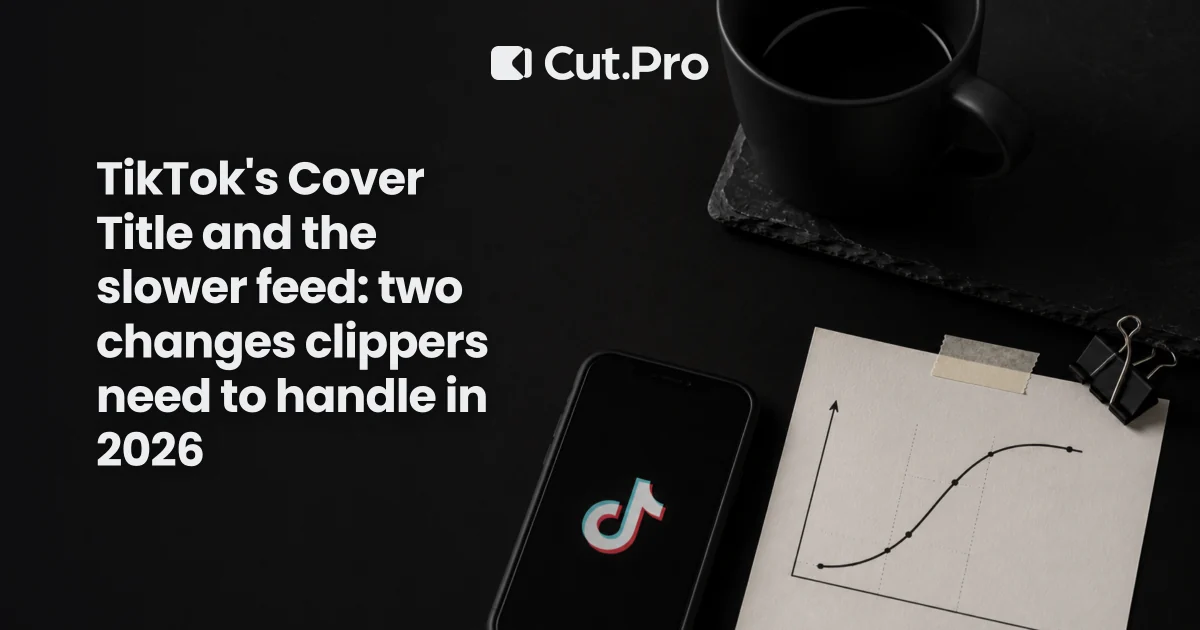
The second change is quieter, and it messes with a lot of people's heads. TikTok started distributing more gradually. Before, a good clip usually gave a quick spike in the first few hours. Now, the video is shown to strangers little by little and grows over time, as audience behavior (how much people watch, like, comment) confirms it's worth pushing to more people.
In practice, this changes one important thing: the first few hours became a less reliable gauge. A clip that looked weak on the first night can take off two or three days later. And that has a direct consequence on behavior: the worst possible reaction is the most common one: publish, see few views in two hours, decide it flopped, and delete. Deleting too early kills a video that was still going to grow.
The smarter path now is to give it time and look at the right metric. Instead of counting views in the first few hours, look at retention: if the people who opened it are watching to the end, the clip has a base to grow on, even if distribution is still slow. If retention is bad, then yes, there's a real problem, but it's a problem with the cut, not with time. I've covered this more carefully in what to do with a clip that flopped: reposting can be worth it, but with a real change to the cover, title, or hook, never on impulse right after publishing.
Where the two changes meet
Notice that both converge on the same point: retention. A well-written Cover Title draws the right tap, from someone who actually wants to see that, and the right audience watches more, which feeds the gradual distribution of the new algorithm. A lying cover title does the opposite: it draws the wrong tap, the person swipes away fast, and the slow feed reads that as "not worth pushing" and stalls the clip before it ever gets a chance.
So the two changes aren't independent. The cover title is the promise; retention is keeping it. In a feed that takes its time and watches behavior before deciding, promising right and delivering matters more than ever. It's the same old reason a caption that holds attention and a firm hook in the first seconds make a difference: except now they decide whether slow growth turns into real growth.
How to set this up in Cut.Pro
The practical part is where the pipeline saves you time. When you process a stream or a podcast in Cut.Pro, on top of the clips with vertical reframe and captions, the platform proposes a title, description, and hook for each clip, in the language of the content. In practice, that hands you a ready starting point for the cover title: you don't start from scratch, you start by tweaking a suggestion that already came out of the moment itself.
The flow I recommend is simple:
- Process the material and review the clips. Pick the moments with a clear beat: tension, a turn, an unexpected answer. That beat is what becomes a good cover title.
- Use the suggested title as a base. Tweak it to point at the tension without giving away the ending, and check that it matches the clip's first frame. Cover and opening have to say the same thing.
- Check the opening before publishing. The first seconds have to deliver on what the title promised. That's the step that decides retention, and retention is what the slow feed is watching.
- Publish and be patient. Don't judge it in the first few hours. Let the clip breathe for a few days, look at the retention curve, and only decide to repost if you have a concrete change to make.
The honest takeaway
Neither change is a shortcut. The Cover Title is a distribution window that exists while the feature is new: worth taking, but what sustains the result is the title being honest and matching the video. And the slower feed isn't an obstacle; it's just a different yardstick, one that rewards whoever holds the audience and punishes whoever gives up on their own clip too early. Both point at the same old discipline: promise with precision on the cover and deliver with retention in the video. Anyone already working that way just got two new tools to do it better.