TikTok stuck at 200 views: what's real and what's myth
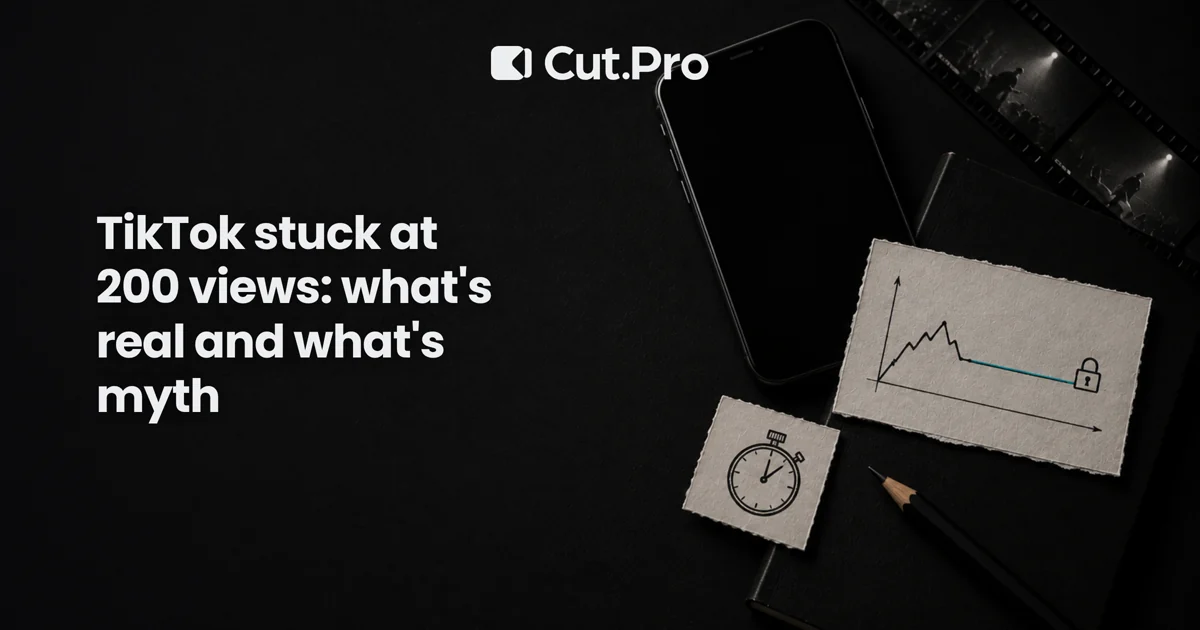
Your video stalls at 200, 300 views and you're already sure it's a shadowban. It almost never is. Here's what TikTok actually confirms, what the data shows, and how to diagnose each breaking point (0, 200, 1k, 10k, 100k) inside TikTok Analytics.
TikTok stuck at 200 views: what's real and what's myth
You cut the best moment of the stream, add captions, post it and watch the counter. 80, 150, 210. Then it stops. The next day, 260. And your brain jumps straight to the worst case: shadowban, burned account, "TikTok put me in 200 view jail".
I get it, it's infuriating. But most of what gets passed around about "200 view jail" was made up, and the parts that are real can be checked inside the app. In this post I separate what TikTok confirms, what the data shows and what creators report (or repeat with no source). And for each breaking point (0, 200, 1k, 10k and 100k) I show how to diagnose it in Analytics and what gets a video past it.
200 views isn't a punishment. It's TikTok's most common outcome
Let's start with the number that should calm you down.
Researchers collected nearly everything posted to TikTok during one hour in April 2024: 5,157,488 posts. In the "Just Another Hour on TikTok" study, the most common view count was around 100. The average was 2,533, dragged up by a handful of giant videos.
Other datasets land in the same range:
- Buffer analyzed 11.4 million posts and found a median of 459 to 506 views per post, no matter how often the account posted.
- At Socialinsider, accounts with 1K to 5K followers averaged 350 views per video in 2025, down 60% from the year before.
- Metricool, across 2.31 million posts, saw views drop 31.3% in a year while the number of videos posted rose 72.1%. More people fighting for the same attention.
In other words: a video stalled between 100 and 500 views is where most TikTok videos stall. It's not a cell, it's the middle of the curve. Restrictions do exist, and I'll show you how to spot them. But the right question isn't "why did TikTok punish me?". It's "why didn't this video convince the first people who saw it?".
What TikTok confirms (and what it has never said)
What's official:
- Every video goes through moderation before it's distributed. On its Transparency Center, TikTok says only videos that pass moderation are included in the recommendation pool.
- Recommendations predict what each viewer will do: finish, skip, share, follow, tap "Not interested". Finishing a longer video carries more weight than a weak signal.
- Follower count and having had a viral video before are not direct factors. TikTok has said this since 2020 and repeats it in its 2026 Analytics guide.
- A video that isn't getting many views "doesn't necessarily mean it broke a rule", according to the For You feed eligibility standards.
What TikTok has never published: batch sizes. There's no official document saying "first we show it to 200 people, then 1,000, then 10,000".
The "first batch of 200 to 500 users" story comes from Chinese explainers about Douyin (TikTok's Chinese sibling) and its "traffic pool", copied into English, Spanish and Portuguese blogs without a source. Numbers like "70% retention unlocks the second wave" have no verifiable origin either. It's folklore. What you can say is that there's a small first test with people who don't follow you, of a size TikTok doesn't reveal.
Breaking point 1: zero views
Zero is not the same as 200. Zero means the video hasn't been shown to anyone yet. The possible causes, all of them checkable:
- Processing or under review. TikTok says a video that was just uploaded or is under review may not be eligible for recommendation yet.
- Ineligible for the For You feed. A warning bar appears at the top of the video's Performance tab, and the record sits in Inbox > Account Status.
- Restricted account, for spam, automation or using another account to dodge a restriction.
- Creator under 16, which isn't eligible for recommendation.
- A platform problem. Between January 26 and 28, 2026, videos got stuck "under review" with 0 views, and TikTok blamed a power outage at a US data center. Sometimes it's not you.
How to diagnose it: look for a warning bar in Performance and open Account Status. Run Account check, which scans the account and your last 30 posts for restrictions, including posts not eligible for the feed. Before your next post, on desktop, use Content check lite, which checks the video against the feed rules before you publish.
What gets you past it: if there's a warning, read the reason and appeal if it makes sense. And don't create another account to get around a restriction: TikTok classifies that as circumvention.
Breaking point 2: between 100 and 500 views
This is the "stuck at 200" the post is named after, and as the data showed, it's the default destination. The video was shown to a small group, people skipped early, few finished, and the prediction didn't justify showing it to more people.
How to diagnose it: the metric that settles it is the traffic source.
- Views almost all from For You and retention falling off a cliff in the first 2 or 3 seconds: the video was tested and lost on the hook. That's not a penalty, that's a swipe.
- For You near 0% and views coming from Following and your profile: the video was never distributed. Now you can suspect ineligibility or a restriction, and go back to the zero-views checklist.
That difference separates a "weak video" from a "blocked video", and it's two taps away in Analytics.
What gets you past it: win the first seconds. TikTok itself tells creators to put the hook in the first 3 seconds and to "trim any lulls and use quick cuts". For clippers, that means opening on the reaction, the strongest line or the tension, not on lukewarm context. One idea per clip, vertical 9:16, captions on screen (TikTok says over 30% of viewers watch on mute).
And stick to a niche. TikTok recommends a specific niche to help the system understand who to show you to. A profile that mixes finance podcast clips with Valorant stream highlights confuses whoever gets the test.
Breaking point 3: around 1k
A thousand views is the first official number in this story, but not as an algorithm turnstile. It's that the Creator Rewards Program requires at least 1,000 views on the For You feed, an original video and a length over one minute. And to count as a qualified view, a view needs at least 5 seconds of watch time, has to be unique per account, and has to come from one of the 8 countries on the list: the US, Mexico, Brazil, South Korea, Japan, Germany, the UK and France.
How to diagnose it: the typical pattern near 1k is a good hook and a weak middle. Retention holds early, but few viewers watch the full video and engagement is flat. People came in, didn't get the payoff, and left. Also check which countries the views come from: TikTok officially uses the region a video was posted from to pick who sees it. (The theories that "your SIM card is the strongest signal" and "a VPN ruins everything" come from people selling VPNs.)
What gets you past it: deliver the ending. A clip that ends on the best part, with no dragging after the punchline. If it runs past a minute, it should be because the moment needs it. That tension is covered in depth in completion rate, the king metric for clips.
Breaking point 4: around 10k
Here the video starts leaving the closest interest bubble, and TikTok applies diversity rules and a "similarity check" that swaps out similar content in a row.
For a sense of scale: at Socialinsider, accounts with 10K to 50K followers averaged 3,240 views per video in 2025, and those with 50K to 100K, 9,900. 10k per video is already above average for almost everyone.
How to diagnose it: a good completion rate, but few shares, few new followers, and a Viewers tab full of people who already knew you. The video lands with your core and doesn't convince outsiders.
What gets you past it: a reason to send it to someone. Industry reports point to shares as a rising signal (Socialinsider measured 13% more shares per post). It's the clip someone drops in the group chat with "look at this": short context, a caption that explains who's who for people who don't know the streamer, an ending that makes you want to tag a friend.
And volume raises the ceiling, not the average. In Buffer's data, posting more doesn't move the median, but the video that beats 90% of the others climbs from 3,722 views (one post a week) to 14,401 (11 or more).
Breaking point 5: 100k and up
TikTok confirms that content gets "a second look when it gains popularity or when someone reports it". A video that grows fast gets reviewed again, and this is the range where a late ineligibility decision or a copyright mute can land. Douyin goes as far as saying officially that the more traffic, the more evaluations and the stricter the standard. For TikTok that's only an analogy, but it fits what TikTok confirms.
There's also "heating", manual boosting done by employees. TikTok said it applies to about 0.002% of videos in For You feeds. It's not something you control.
How to diagnose it: a spike and a sudden stop, sometimes with muted audio or a warning showing up later. Check Account Status and the sound.
What gets you past it: content that holds up under a closer look. Genuinely original, licensed audio (TikTok offers a music pre-check on the posting screen), no one else's watermark.
Diagnosis table: what Analytics is telling you
| Symptom in Analytics | What it probably means | What to do |
|---|---|---|
| 0 views, "under review" or processing | The video hasn't cleared moderation yet | Wait, check whether the app is down for everyone, don't panic-repost |
| Warning bar in Performance or a notice in Account Status | Video ineligible for For You | Read the reason and appeal if it makes sense |
| For You near 0%, views from Following and profile | Video not distributed (ineligible content or restricted account) | Run Account check and review your recent posts |
| For You high, sharp drop in the first 2 or 3 seconds | The hook lost the test | Open on the reaction or the strongest line |
| Good early retention, few viewers watch the full video | Saggy middle or no payoff | Cut the lulls and end on the punchline |
| Good completion, few shares, mostly returning viewers | Lands with the core, doesn't cross over | Context for newcomers and a shareable ending |
| Views from countries that aren't your audience | Region or language mismatch | Aim at the right region; outside the 8 countries it doesn't count for rewards |
| Spike then stop, sometimes with muted audio or a late warning | Popularity review or copyright | Check Account Status and the sound |
| Search growing as a source | Long-tail discovery | Write the title and text for search (counts for rewards if watched 30s or more) |
If you clip streams and podcasts, read this twice
Clippers have an extra layer, and it's the heaviest official lever: originality.
TikTok's originality policy defines content as unoriginal when it is:
- copied completely;
- "largely repurposed from another source without adding any creative edits";
- combined from multiple sources with little or no additional information or value;
- carrying someone else's visible watermark or superimposed logo.
Read items 2 and 4 with a stream clip in mind. A chunk of the stream, no edits, with the streamer's overlay and logo in the corner: that's the example the rules themselves use. The guidelines literally list "clips that show someone else's watermark or logo" as ineligible for For You.
And here's the risk almost nobody knows about. In the accounts section of the guidelines, TikTok says that accounts that don't break any rules but post a lot of ineligible content can have the whole account made ineligible for For You and harder to find. It's not one video getting stuck. It's the account. And in Creator Rewards: 5 or more ineligible videos in the past 30 days may disqualify the account.
What TikTok counts as transformation, from its own Creator Academy guides:
- In reaction and commentary, your voice or voiceover needs to be the majority of the video.
- In edits, at least 3 unrepeated clips, and the majority of the video shouldn't be a single clip.
- In the guide to turning long-form into short-form, which is the podcast and stream case: one moment per clip, a new hook the original didn't have (text or voiceover), 9:16, auto-captions, no letterboxing, and native elements like Green Screen. For podcasts, TikTok suggests "just over one minute" and split screen with no black margins.
What doesn't save you: blurring the watermark (creators report it still gets flagged) and just adding captions over the original audio (I only found that one in third-party interpretations, not in the official text, so treat it as a warning).
Another risk: if a hundred clippers cut the same moment from the same VOD, the videos end up alike, and TikTok has said since 2020 that it doesn't recommend duplicated content (how that gets detected is covered in duplicate video detection). Finding the moment nobody clipped beats being first to the one everybody clipped. And posting the identical clip across several accounts counts as spam and circumvention under the guidelines.
Myths that are wasting your time
"There are fixed tiers at 200, 1k and 10k." No TikTok source. It comes from Douyin explainers copied without citation.
"#fyp and #viral unlock the For You feed." An academic study found the advantage of viral hashtags shrinking over the years, and Metricool measured only about 5% more views on posts with hashtags. TikTok suggests 3 or 4 relevant hashtags: they're a topic and search signal, not a key.
"Delete and repost to reset." TikTok doesn't recommend duplicated content, so the same file isn't a fresh start, it's a copy. What works is re-editing with a different opening, hook and length, as I showed in what to do with a clip that flopped. (The opposite claim, "deleting videos hurts your account", has no confirmation either.)
"0 views means shadowban." "Shadowban" isn't even a TikTok term. The official terms are "ineligible for the For You feed" and "restricted", and both show up in the app. Zero can be processing, review, an outage or ineligibility, and all of that can be checked.
"Joining Creator Rewards kills your reach." TikTok answers this directly: joining doesn't affect your views.
"A new account has to warm up or it'll never leave zero." There's no official source, and the people pushing it hardest are companies selling multi-account tools. Acting like a normal person for the first few days doesn't hurt, and there's a sensible routine in how to warm up a new account. But no data shows warming up changes the reach of later videos. If the clip doesn't hold in the first seconds, a warmed-up account won't save it.
"The first hour decides everything." No primary source. What does exist is Metricool's figure: 96% of reach and 98% of interactions happen in the first 10 days. In that full-hour TikTok study, the median comment arrived almost 30 hours after posting. That's why I give a clip two or three days before deciding it's stuck, and after about 10 days I assume it has delivered nearly everything.
Where Cut.Pro fits in
Almost everything that unsticks a 200-view clip is editing work, not luck. With Cut.Pro you paste the link to the stream, VOD or podcast, and the tool finds the best moments, reframes them vertically following the face, adds captions and suggests a title and hook for each clip. When a clip stalls, you can generate variations of the same segment, changing the opening, the hook and the highlighted caption, instead of reposting the same file. And on paid plans the export comes out with no watermark.
What the tool doesn't do for you is the creative contribution: your voiceover, your commentary, the context you add. That part is still yours, and it's what protects the account.
TL;DR
Stalling between 100 and 500 views is the normal statistical outcome, not a penalty, and TikTok has never published batch sizes. The question that settles it is in Analytics: did For You test the video or not? And for clippers, the strongest lever is originality, because too much ineligible content stalls the entire account.
If you post the same clip on other platforms, the breaking points look similar but the rules change. The same breakdown exists on Instagram, with Reels stuck at 200 views, and on YouTube, with Shorts stuck at low views.