Tubi pays creators to make series and lets them keep the rights
Tubi, Fox's free streaming service, pays a guaranteed fee for exclusive creator series and leaves the intellectual property with the people who made them, according to the executive who runs the program. Here's how the deal works, what isn't written down anywhere yet, and what it means for creators in Brazil.
Tubi pays creators to make series and lets them keep the rights
Tubi, Fox's free ad-supported streaming service, pays a guaranteed fee for exclusive creator series and leaves the intellectual property with the people who made them. That comes from Rich Bloom, Tubi's general manager of creator programs, in an interview with Net Influencer published Tuesday (Nov. 24). Tubi does not officially operate in Brazil.
What interests me here is the shape of the contract. Studios and streamers usually buy the idea along with the series. Tubi is paying for the airing window and handing back everything else, because what it wants from the creator is the audience that comes along.
How does Tubi's deal with creators work?
There are two steps. First, Tubi licenses videos the creator already has, non-exclusively, and shares the ad revenue. If the content does well, it usually proposes an exclusive: a guaranteed fee, with a bonus if the series performs.
From what Bloom described, exclusivity lasts "usually a few months," during which the series only streams on Tubi. After that it stays in Tubi's catalog for a while, and the creator can take it to YouTube, social platforms, and other services. The intellectual property and creative control stay with the creator.
The contracts aren't public. The advance amount, the exact length of the window, and the territory don't appear in any source I read, and that matters: "a few months" could be three or it could be twelve.
Bloom also said the idea has to come from the creator. A project shaped by Tubi, he said, is less likely to work.
Why does Tubi want creators?
Because creators bring in people Tubi doesn't have. According to Tubi's own numbers cited in the interview, the service has 110 million monthly active users, 68% of its viewers aren't on TikTok, and close to 30% aren't on YouTube. About 60% of the audience is Gen Z or millennial.
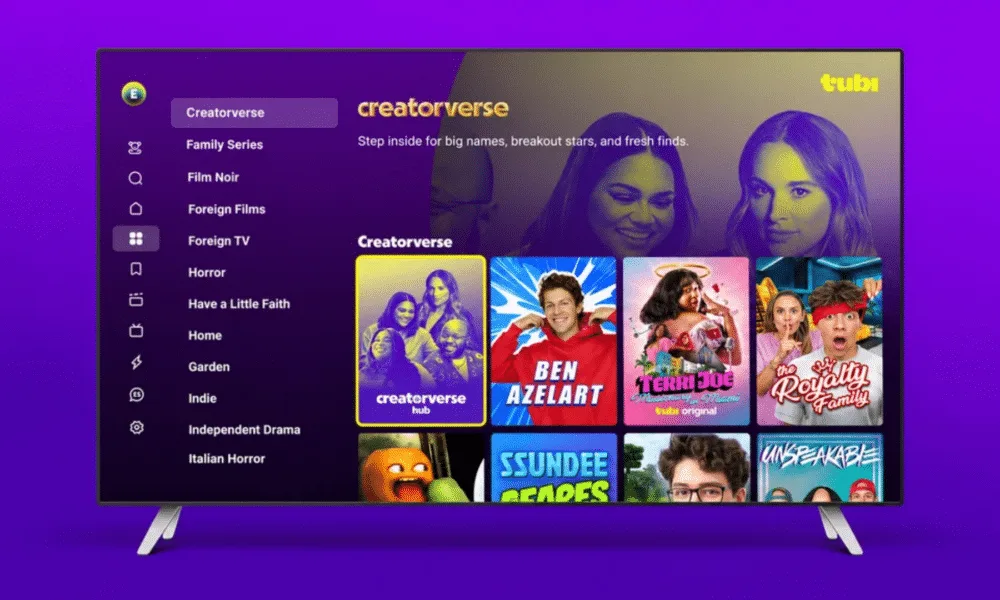
The math is simple: every creator series is a promotional campaign the creator runs for their own base. Tubi says it has more than 70 creator exclusives and originals in the program, with eight creators who have made more than one. The cases cited:
- KevOnStage, a comedian, had the second season of "Safe Space" funded after the first one worked. His deal includes comedy series, a stand-up special, and two films.
- Noah Beck starred in "Sidelined: The QB and Me," an adaptation of a Wattpad story that Bloom calls Tubi's biggest original hit.
- Kelon Campbell took "Terri Joe: Missionary in Miami," which came out of Stubios (the fan-driven studio created with Issa Rae), to eighth place in the streaming originals ranking.
The money has another side, too. Tubi closed its first ad packages built around creator content, and a brand can sponsor an exclusive series. Bloom admitted there are no advertiser results to show yet.
What programs does Tubi have for creators?
Three doors, all with selection done by Tubi:
| Program | What it is | Status as of Nov 25, 2026 |
|---|---|---|
| License and exclusives | Existing videos with revenue share, then an exclusive series with a guaranteed fee | Exclusive offered by Tubi to those already doing well on the license |
| Creatorverse, with TikTok | 10 series from 12 TikTok creators, promoted through TikTok's Spotlight | Cohort announced on October 27, no budget or premiere date |
| Fandom Fund, with Kickstarter | $250,000 for independent films and series, with an exclusive premiere on Tubi starting in 2027 | Launched on November 13, Kickstarter nominates candidates and Tubi chooses |
On the Fandom Fund, according to Analytics Insight, about $150,000 is split among 8 to 15 creators and $100,000 goes out as matching funds to turn a project into a full series or film. The creator keeps the rights and Tubi keeps the exclusive window. It's not much money per project: on average, $10,000 to $19,000 for each selected creator, not counting what the matching funds add.
What changes for you
For creators in Brazil, nothing changes right away. Tubi has no official launch there (the latest expansion in Latin America was to Costa Rica, Ecuador, El Salvador, Guatemala, and Panama), and none of the three programs has announced openings for Brazilians.
What changes is the yardstick for contracts. Until recently, a creator series on streaming came with a rights transfer as the price of entry. Tubi shows you can pay for just the window, and YouTube is chasing with its own series, as I covered in the post on Creator Premieres. When a broadcaster, streamer, or brand comes to you with a series offer, you already have a public example to ask for the same.
And the model confirms what the market has been saying: whoever buys creator content is buying audience. It was the same logic behind Disney+ with TikTok videos and Viih Tube's digital network.
What to do now
- Sort out what could already become a series. Tubi starts by licensing existing videos. A recurring segment with a beginning and an end is what sells; the catalog route is in back catalog turns into income.
- Read any series offer through four questions: how much is guaranteed, how long the exclusivity lasts, in which countries, and who owns the format afterward. If the answer to the last one is "the platform," the fee has to make up for it.
- Prove your audience moves. Tubi's argument is the fan who follows the creator to another screen. Short video that sends people to the long content is the proof. In Cut.Pro, you paste the episode link, AI picks the moments that stand on their own, already vertical and with captions, and the same dashboard schedules to TikTok, Instagram, Facebook, Threads, X, LinkedIn, Bluesky, Pinterest, Telegram, Mastodon, Discord, Dailymotion, Tumblr, Slack, Car.Media, and YouTube.
- Don't count on Tubi in Brazil. Treat the program as a negotiation reference, not as an income plan for 2027.
I'll add one caveat: everything known about the terms comes from Tubi itself, in an interview. Until someone publishes a contract, "the creator keeps the rights" is the company's promise, and the fine print is in the length of the window.