Unilever cuts TV spend in half and moves the money to creators: what changes
Unilever cut its UK TV spend by more than half in 2026 and now works with over 500,000 creators. Here is why creators became a core media channel for the brand, who wins and who loses, and what it gives you to use when you negotiate a brand deal.
Unilever cuts TV spend in half and moves the money to creators: what changes
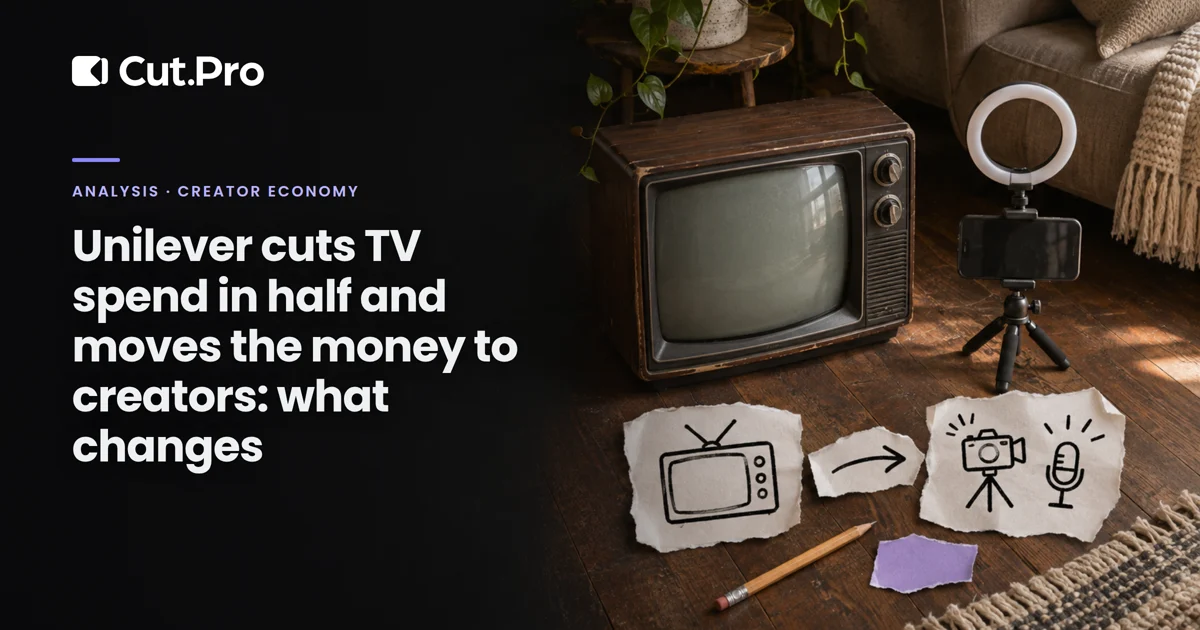
Unilever, owner of Dove, Rexona, Hellmann's and Knorr, cut more than half of what it spends on TV in the UK in 2026 and moved the money to content creators, according to industry figures obtained by The Guardian. My take: for one of the world's biggest advertisers, creators stopped being a test budget and became the main media channel, and that changes the argument for anyone sitting down to negotiate a brand deal.
What did Unilever cut, and where?
The cut is in British TV, and it is deep. According to the figures gathered by the Guardian and picked up by Retail Gazette, the company's UK TV spend fell by more than 50% in 2026 compared with 2025. On Channel 4 the drop was about 92%. On ITV, 42%. At Sky's advertising arm, which also sells Channel 5, 44%.
In money terms, Unilever spent about £92 million on British TV in 2025 and reached £122 million in 2023. Channel 4 said Unilever remains a "valued partner". There is no confirmation of a similar cut in Brazil or other countries: the data is for the UK.
Where did the money go?
To creators, at industrial scale. At the investor event on November 4 in New York, the company said the network of creators it works with grew from about 75,000 in 2024 to more than 500,000, as B&T reported. Global marketing chief Leandro Barreto summed it up: "creators now shape what people believe".
This was not a one-quarter decision. In March 2025, CEO Fernando Fernandez said he would move half of the media budget to social media (up from about 30%) and work with 20 times more influencers, according to The Drum. In April 2025, on his first earnings call as CEO, he repeated the idea of "covering every zip code with influencers" when talking about the company's brands, as MediaCat reported.
At the 2026 World Cup, Unilever worked with 50,000 creators and distributed more than 100,000 pieces of content across 120 markets, according to the same B&T report.
Why does the brand prefer creators to TV?
Because, by Unilever's own math, creator-made content returns 1.5 times the return of brand-produced content. The number comes from the company, not an independent audit, so treat it as the argument it uses internally, not as a market truth.
There is a second reason that weighs just as much: production cost. Unilever says it produces 12 times more content than in 2024, at an average cost 90% lower, and that producing a video went from three weeks to three hours. A TV commercial is expensive, slow and comes in one version. A creator delivers dozens of versions, each speaking to a different audience.
And it is not just Unilever. The Guardian tells the story of Kathryn Turner, product development director at M&S Food: she had about 30 TikTok followers in May and reached around 700,000 across TikTok and Instagram. One of her videos about a chocolate cornflake cookie caused queues and panic buying in some stores. The brand is learning to be a creator, and to hire creators the way it buys media.
The same movement shows up in the global numbers: consultancy Madison & Wall estimates that advertisers will spend US$ 116 billion on creators in 2026, as we covered here.
Who wins and who loses?
TV loses budget and more creators win contracts. But more money in the industry does not mean more money per creator.
CreatorIQ's State of Creators 2026 survey, with about 5,000 creators, paints the picture:
| CreatorIQ data (August 2026) | Number |
|---|---|
| Earn less than US$ 10,000 a year from content | Two thirds |
| Earn more than US$ 100,000 a year | About 5% |
| Depend on brand deals for most of their income | 46% |
| Mostly do one-off deals | 42% |
| Mostly do long-term partnerships | 12% |
| Cite lack of steady brand deals as the biggest barrier | 35% |
When a company goes from 75,000 to 500,000 creators, the budget gets spread thin. There are more contracts, each one smaller, and whoever buys at scale wants to compare everyone with the same yardstick. We have already covered the rate card by follower count that is dying out and the brands that now build their own score to decide which post to pay for.
Is TV right about anything?
Yes, and it is worth listening before concluding that TV is dead. Thinkbox, the body that represents British commercial TV, says broadcast TV generated 39% of the uplift in campaign recall, against 1% attributed to influencers, according to Retail Gazette. Thinkbox chief executive Lindsey Clay called the budget shift "self-destructive", according to the Guardian. That is TV defending its own business, but the point is real: creators sell well and persuade well, and are still less proven at building a brand from scratch.
Jessica Tamsedge, from Dentsu Creative in the UK, told the Guardian that results vary a lot and that using a creator is not, by itself, good marketing. Translated for anyone doing brand deals: if the brand does not see a return on your video, it swaps you for one of the other 500,000.
What does this change in your brand deal negotiation?
It changes the vocabulary. A brand taking money out of TV to put it on you is buying media, so the proposal that works is the one that speaks the language of media.
- Sell delivery, not followers. Bring your average views over the last 30 days and the cost per thousand views your proposal implies (how much the brand pays for every thousand views). That is the number the media buyer compares with TV.
- Charge for ad usage separately. Unilever says creator content returns 1.5 times more than its own. If so, your video is going to become a paid ad. Usage rights, duration and exclusivity have a price, as we explain in brands now pay creators to make their ads.
- Offer a recurring package. Only 12% of the creators in the survey live off long-term partnerships, and a brand working with thousands of creators wants predictability. Three months with four videos a month is easier to approve and renew than a single post. What goes into the contract is in brand deals from the inside.
- Deliver versions, not one video. The reason brands swap TV for creators is content volume. One long campaign video can become five vertical clips with captions, each testing a different hook. You can do this in Cut.Pro, which cuts the video with AI, adds captions and publishes to your own social accounts, and charge for the pack of versions as a line item in your proposal.
- Disclose the sponsorship. In the same CreatorIQ survey, 13% of creators say a clear sponsorship disclosure is what makes them trust another creator's sponsored content. A big brand does not want regulatory risk with 500,000 people speaking on its behalf.
My take
The good side: money that used to go to a 30-second commercial is now available to people with a niche audience. The catch: that money comes with a media yardstick. Whoever charges by follower count and delivers one post becomes a replaceable supplier, and the price drops.
The creator who does well in this shift is the one who measures their own results before the brand does. That is also why clipping championships for brands started showing up as a budget line: it is media paid per view delivered.
Starting today, I would do three things: write down the average views and the cost per thousand views you deliver, separate the price of the post from the price of ad usage in your budget, and put together a monthly package proposal for the next brand that shows up.
Frequently asked questions
Did Unilever really cut its TV advertising?
In the UK, yes. Industry figures obtained by The Guardian show that Unilever's spend on British TV fell more than 50% in 2026 compared with 2025, with a drop of about 92% on Channel 4. The company has not announced the same cut for other countries, including Brazil.
How many influencers does Unilever work with?
At its investor event in New York in November 2026, Unilever said it works with more than 500,000 creators worldwide, up from about 75,000 in 2024. The goal CEO Fernando Fernandez stated in 2025 was to multiply the number of influencers by 20 and move half of the media budget to social media.
Does a brand spending more on creators mean creators earn more?
Not necessarily. CreatorIQ's State of Creators 2026 survey, with about 5,000 creators, shows that two thirds earn less than US$ 10,000 a year from content and only about 5% make more than US$ 100,000. The budget is being spread across many more creators, which increases the number of deals but not the value of each one.
How can you use this shift to negotiate brand deals?
Pitch your proposal as a media buy: delivery in views, cost per thousand views and the right to use the video in ads. Offer a recurring package instead of a one-off post, because a brand working with thousands of creators wants predictability, and charge separately when the video becomes a paid ad.